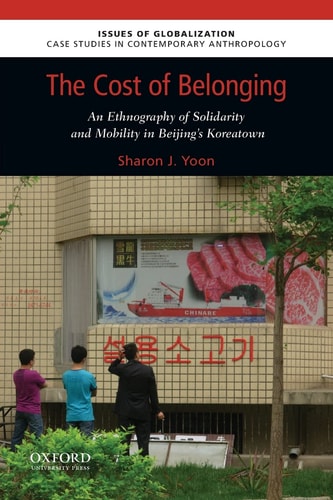
The Cost of Belonging: An Ethnography on Solidarity and Mobility in Beijing's Koreatown
0
0
As an Amazon Associate and affiliate partner, Menrva Books earns from qualifying purchases. Learn more
Author Description
In the past ten years, China has rapidly emerged as South Korea's most important economic partner. With the surge of goods and resources between the two countries, large waves of Korean migrants have opened small ethnic firms in Beijing's Koreatown, turning a once barren wasteland into the largest Korean enclave in the world. The Cost of Belonging: An Ethnography of Solidarity and Mobility in Beijing's Koreatown fills a critical gap in East Asian and migration studies through an investigation of how the rise of transnationalism has impacted the social and economic lives of South Koreans searching for wealth and stability in China. Based off in-depth ethnographic fieldwork, this book studies the tensions, relationships, and perceptions in the ethnic enclave of Wangjing between Korean Chinese cultural brokers and South Koreans starting out as entrepreneurs.Expanding upon classic anthropological theories of community and space, Yoon broadens our understanding of the migrant middle class in the era of global capitalism and neoliberal markets. The transnational enclave was once an incubator of the middle class dream, but does it continue to provide its inhabitants with the emotional resources to achieve both wealth and community? The Cost of Belonging challenges theoretical assumptions that transnationalism leads to a renaissance of ethnic identity and greater opportunities for migrants, unpacking how these entrepreneurs and dreamers coexist and evolve, both emotionally and financially, in the era of globalization.The Cost of Belonging is a volume in the series ISSUES OF GLOBALIZATION: CASE STUDIES IN CONTEMPORARY ANTHROPOLOGY, which examines the experiences of individual communities in our contemporary world. Each volume offers a brief and engaging exploration of a particular issue arising from globalization and its cultural, political, and economic effects on certain peoples or groups.
Menrva's Summary
THE THESIS
Does the transnational enclave of Beijing's Koreatown serve as a viable incubator for migrant success, or does it impose hidden social and economic costs on its inhabitants? Sharon J. Yoon, an expert in migration and ethnic studies, utilizes extensive ethnographic fieldwork to examine the lived experiences of South Korean entrepreneurs and cultural brokers in Wangjing. The book argues that the promise of the middle-class dream within these spaces is complicated by shifting neoliberal market pressures and the complex, often strained, relationships between different segments of the Korean diaspora in China.
THE SCOPE MAP
What You Will Find
- Analysis of the socio-economic dynamics within Wangjing, the world's largest Korean enclave.
- Examination of the interactions between South Korean entrepreneurs and Korean Chinese cultural brokers.
- Qualitative data derived from in-depth ethnographic interviews and long-term participant observation.
- Theoretical critique of how transnationalism impacts ethnic identity and economic mobility in globalized markets.
THE AUTHORITY PERSPECTIVE
Scholars in anthropology and migration studies recognize this work as a significant contribution to understanding the complexities of contemporary ethnic enclaves. Readers frequently note the clarity of the prose, which makes dense sociological concepts accessible while maintaining rigorous academic standards.
Page Count:
208
Publication Date:
2020-11-02
Publisher:
Oxford University Press
ISBN-10:
0197517900
ISBN-13:
9780197517901
Economics
Globalization
Migration Studies
Asia history
China
South Korea
Sociology
Anthropology
Community Tags
Similar Books