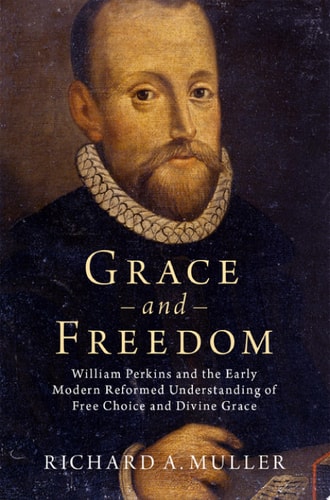
Grace and Freedom: William Perkins and the Early Modern Reformed Understanding of Free Choice and Divine Grace
0
0
As an Amazon Associate and affiliate partner, Menrva Books earns from qualifying purchases. Learn more
Author Description
Grace and Freedom addresses the issue of divine grace in relation to the freedom of the will in Reformed or "Calvinist" theology in the late sixteenth and early seventeenth century. It focuses on the work of the English Reformed theologian William Perkins, especially his role as an apologist of the Church of England, defending its theology against the Roman Catholic polemic, and specifically against the charge that Reformed theology denies human free choice. Perkins and his Reformed contemporaries affirm that salvation occurs by grace alone and that God is the ultimate cause of all things, but they also insist on the freedom of the human will and specifically the freedom of choice in a way that does not conform to modern notions of "libertarian freedom" or "compatibilism." In developing this position, Perkins drew on the thought of Reformers such as Peter Martyr Vermigli and Zacharias Ursinus, on the nuanced positions of medieval scholastics, and several contemporary Roman Catholic representatives of the so-called "second scholasticism." His work was a major contribution to early modern Reformed thought both in England and on the continent. His influence in England extended both to the Reformed heritage of the Church of England and to English Puritanism. On the continent, his work contributed to the main lines of Reformed orthodoxy and to the piety of the Dutch Second Reformation.
Menrva's Summary
THE THESIS
This book investigates how early modern Reformed theologians, specifically William Perkins, reconciled the doctrine of divine grace with the concept of human free choice. Richard A. Muller, a preeminent scholar of post-Reformation Reformed theology, utilizes a rigorous historical-theological framework to analyze Perkins's defense of the Church of England's position. By examining primary source polemics and scholastic influences, Muller argues that these thinkers maintained a nuanced view of human agency that defies modern binary categorizations of freedom. The study situates Perkins within a broader intellectual tradition that bridges medieval scholasticism and early modern orthodoxy.
THE SCOPE MAP
What You Will Find
- Analysis of late sixteenth and early seventeenth-century Reformed theology.
- Examination of William Perkins's role as an apologist against Roman Catholic polemics.
- Historical context regarding the influence of Peter Martyr Vermigli and Zacharias Ursinus.
- Exploration of the distinction between early modern concepts of free choice and contemporary notions of libertarianism or compatibilism.
THE AUTHORITY PERSPECTIVE
Scholars and theologians frequently cite this work as a definitive resource for understanding the complexities of Reformed scholasticism. Readers often note the high level of academic density and the meticulous attention to historical detail that characterizes Muller's research.
Page Count:
244
Publication Date:
2020-01-01
Publisher:
Oxford University Press
ISBN-10:
019751748X
ISBN-13:
9780197517482
Philosophy
History
Biography
Religion
Theology
Christianity
Reformation
Community Tags
Similar Books