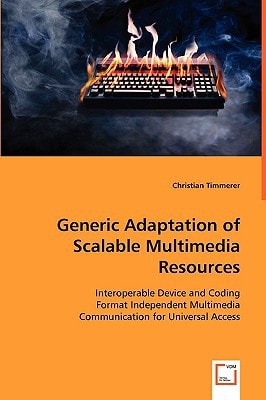
Generic Adaptation of Scalable Multimedia Resources
0
0
As an Amazon Associate and affiliate partner, Menrva Books earns from qualifying purchases. Learn more
Author Description
Over the last decade, a wide spectrum of multimedia resource formats has become available to an increasing number of users who desire to access it through various devices and over heterogeneous networks. This book describes means for device and coding format independent access to advanced multimedia resources in an interoperable way. That is, it addresses issues as indicated in the scenario above which are generally referred to as Universal Multimedia Access (UMA). In particular, it proposes a generic XML-based multimedia publishing framework which allows the adaptation of advanced multimedia resources in a coding format independent way. XML is used to describe the high-level structure of the multimedia resources which enables the adaptation thereof using standardized processes. The XML document describing the structure of the multimedia resource is transformed using traditional XML transformation languages and a generic processor generates the adapted multimedia resource by means of the transformed XML document. The metadata overhead is reduced by using an appropriate encoding scheme (MPEG BiM) for which an API is proposed enabling the adoption into network-enabled devices.
Menrva's Summary
THE THESIS
This book addresses the challenge of providing device and coding format independent access to advanced multimedia resources. It proposes a generic XML-based framework for adapting multimedia content, enabling interoperability across various devices and networks. The approach utilizes XML to describe the high-level structure of multimedia resources, allowing for adaptation through standardized XML transformation processes. A generic processor then generates the adapted resource based on the transformed XML document, with an API proposed for efficient encoding (MPEG BiM) to reduce metadata overhead on network-enabled devices.
THE SCOPE MAP
- A description of multimedia resource formats and user access trends over the last decade.
- A proposed generic XML-based multimedia publishing framework.
- Methods for device and coding format independent access to multimedia resources.
- Utilization of XML for describing high-level multimedia resource structure.
- Application of traditional XML transformation languages for adaptation.
- A generic processor for generating adapted multimedia resources.
- An API proposal for an appropriate encoding scheme (MPEG BiM) to reduce metadata overhead.
THE AUTHORITY PERSPECTIVE
The book presents a technical framework for Universal Multimedia Access (UMA), focusing on XML-based adaptation of multimedia resources. The proposed system aims to ensure interoperability across diverse devices and networks by decoupling content structure from specific coding formats. The technical depth suggests it is aimed at researchers and developers in the multimedia and computer science fields. The detailed description of the XML transformation process and the MPEG BiM encoding indicates a focus on practical implementation and efficiency.
Page Count:
176
Publication Date:
2008-01-01
Publisher:
KS Omniscriptum Publishing
ISBN-10:
3639003969
ISBN-13:
9783639003963
Non-Fiction
Science & Technology
Digital Media
Multimedia
Networking
Computer Science
XML
Community Tags
Similar Books