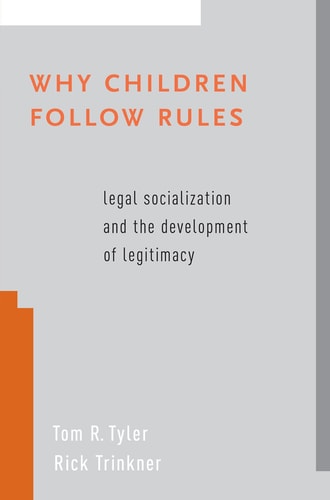
Why Children Follow Rules: Legal Socialization and the Development of Legitimacy
0
0
As an Amazon Associate and affiliate partner, Menrva Books earns from qualifying purchases. Learn more
Author Description
As with all social institutions, learning about law and how to relate to it is an important part of growing up. In Why Children Follow Rules, Tom R. Tyler and Rick Trinkner focus on legal socialization, the process by which children and adolescents form their orientation toward the law, and outline what is known about the process across three related, but distinct, contexts: family, school, and the juvenile justice system. They emphasize the degree to which individuals develop their orientations toward law upon values of responsibility and obligation, as opposed to fear of punishment. They further argue that when individuals experience authority that is fair, respectful, and aware of the limits of power, they are more likely to consent and voluntarily follow directives. Yet, strong pressures and popular support for the exercise of authority based on dominance and force persist. Given the low levels of public trust and confidence in the police, as well as the legal system in general, Why Children Follow Rules offers an invaluable tool for understanding how people come to understand their relationship with the law.
Menrva's Summary
THE THESIS
This book investigates the developmental processes through which children and adolescents form their orientations toward legal authority and the role of legitimacy in fostering compliance. Tom R. Tyler, a professor of law and psychology, and Rick Trinkner utilize extensive research on social psychology and legal studies to argue that voluntary compliance is rooted in values of responsibility and obligation rather than fear of punishment. The authors examine how experiences with authority figures in family, school, and juvenile justice settings shape an individual's long-term relationship with the law. By contrasting models of dominance-based authority with those based on fairness and respect, the text provides a framework for understanding public trust in legal institutions.
THE SCOPE MAP
What You Will Find
- Analysis of legal socialization across three primary developmental contexts: family, school, and the juvenile justice system.
- Theoretical framework comparing compliance based on fear versus compliance based on perceived legitimacy.
- Empirical evidence regarding the impact of fair and respectful authority on adolescent behavior.
- Discussion of the societal implications of public trust and confidence in police and legal systems.
THE AUTHORITY PERSPECTIVE
Experts in criminology and developmental psychology identify this work as a foundational text for understanding the intersection of social authority and individual moral development. Readers frequently note the academic density of the prose, which serves as a rigorous resource for researchers and policy practitioners alike.
Page Count:
280
Publication Date:
2020-03-03
Publisher:
Oxford University Press
ISBN-10:
0197520693
ISBN-13:
9780197520697
Psychology
Law
Criminology
Education
Sociology
Community Tags
Similar Books