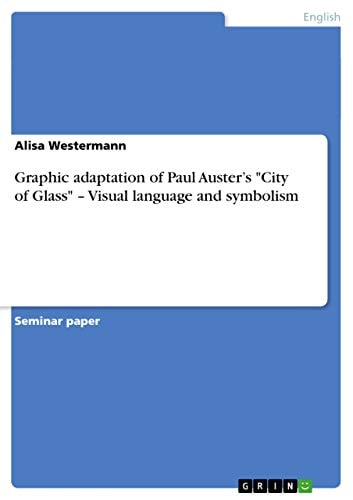
Graphic Adaptation of Paul Auster's City of Glass: Visual Language and Symbolism
0
0
As an Amazon Associate and affiliate partner, Menrva Books earns from qualifying purchases. Learn more
Author Description
Seminar paper from the year 2009 in the subject English Language and Literature Studies - Literature, grade: 1,3, University of Münster (Englisches Seminar), course: Graphic Novels, language: English, abstract: It was a wrong number that started it, the telephone ringing three times in the dead of night, and the voice on the other end asking for someone he was not. (Auster, 1985; 3) Paul Auster's anti-detective novel City of Glass is the story of a man, whose life accidentally angles off. More and more, he blunders into the complexity of a criminal case in search of the significant principle. Obsessively, he adapts his action to the stranger until he finally loses hisself. Although Auster's novel, which is based on the nature and the function of language, is rather non-visual, Paul Karasik and David Mazzucchelli succeeded in adopting it into a graphic novel that is more than just a translation from one genre into another. They managed to create a visual language full of metaphors, symbols and icons that add a new layer of meaning to the story. This is the reason why I decided to pick City of Glass: The graphic novel as the basis of my term paper. This thesis will argue that a graphic adaptation of a literary work can be more than just an illustrated copy of a superior novel and worth an analysis on its own. Furthermore, I will take a deeper look at the visual language, specifically, the visual metaphors and symbols, which build up the graphic novel and how these finding can be adapted into learning situations. First of all, I will give a summary of City of Glass: the novel followed by a definition of the anti-detective genre with the intention to point out, that the visual language of City of Glass: the graphic novel reflects this genre. Afterwards, a survey of the graphic novel as well as an analysis of its structure and composition and its visual language and symbolism is given. A brief outline of how these findings can be useful in teaching and learning situa
Menrva's Summary
THE THESIS
This paper investigates the visual language and symbolism employed in the graphic novel adaptation of Paul Auster's City of Glass. The author, Alisa Westermann, a graduate of the University of Münster, examines how the graphic novel, by Paul Karasik and David Mazzucchelli, transcends mere illustration to create its own meaningful layer. The analysis focuses on the visual metaphors and symbols that contribute to the graphic novel's unique interpretation of Auster's anti-detective novel, arguing for its independent analytical value. Westermann also explores the potential applications of these findings in educational contexts.
THE SCOPE MAP
- Analysis of Paul Auster's novel City of Glass as a precursor.
- Definition and characteristics of the anti-detective genre.
- Exploration of the graphic novel medium as an adaptation.
- Detailed examination of the graphic novel's structure and composition.
- In-depth analysis of the visual language, including metaphors and symbols.
- Discussion of the adaptation of these visual findings into teaching and learning situations.
THE AUTHORITY PERSPECTIVE
This seminar paper, originating from the University of Münster, offers a focused academic analysis of the graphic novel adaptation of Paul Auster's City of Glass. The work is structured to demonstrate that graphic novel adaptations can possess their own intrinsic merit and warrant independent critical study. It specifically highlights the visual metaphors and symbols that contribute to a new layer of meaning, suggesting their utility in educational settings. The paper's approach is analytical, dissecting the visual language to understand its role in interpreting the literary source.
Page Count:
20
Publication Date:
2011-06-01
Publisher:
GRIN Verlag
ISBN-10:
3640935187
ISBN-13:
9783640935185
Non-Fiction
Literary Criticism
Adaptation Studies
Graphic Novels
Symbolism
Community Tags
Similar Books