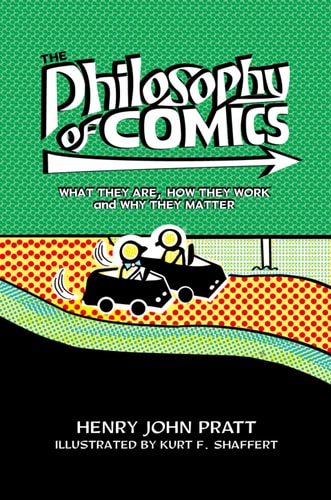
The Philosophy of Comics: What They Are, How They Work, and Why They Matter
0
0
As an Amazon Associate and affiliate partner, Menrva Books earns from qualifying purchases. Learn more
Author Description
How do comics produce such a striking range of vibrant stories, representations, and expressions of the sensibilities of their creators? Henry John Pratt's The Philosophy of Comics provides a ground-breaking, illustrated introduction to the study of comics and graphic novels, advancing the field of comics studies by attending to some of its most notable problems. Pratt examines the history of comics, the contrast between comics and cartoons, the tenuous place of comics in the art world, and what it is to be a comic in the first place. Comics work through extensive modes of representation and expression, including through film, non-graphic literature, and theatre. Pratt examines questions such as, why and how are so many films based on comics? Can there be a perfect adaptation from one to the other? Are some comics better than others? Why is reading comics not regarded in the same light as reading literary books? Pratt urges us to look closely at the most significant problems and puzzles that comics provoke, having to do with the very nature of comics, what composes them, how comics are related to other art forms, how they function to manage space and time in storytelling, and why they've been neglected in academic circles despite being a culturally significant art form for decades. With illustrations by Kurt F. Shaffert, The Philosophy of Comics ultimately tries to explain the true underlying value of comics as an art form.
Menrva's Summary
THE THESIS
This book investigates the ontological and aesthetic status of comics to determine their unique function as a legitimate art form. Henry John Pratt, a scholar in the field of aesthetics, utilizes a philosophical framework to analyze the structural and cultural components of the medium. By synthesizing historical context with analytical inquiry, he addresses why comics have historically occupied a peripheral position in academic and artistic discourse.
THE SCOPE MAP
What You Will Find
- Historical evolution of the comics medium
- Comparative analysis between comics, film, and literature
- Philosophical inquiry into the nature of representation and expression
- Examination of the relationship between space and time in sequential art
Scope Limits
- Does not provide a comprehensive history of every comic book publisher
- Does not serve as a technical manual for creating comics
THE AUTHORITY PERSPECTIVE
Experts identify this text as a significant contribution to the burgeoning field of comics studies, noting its ability to bridge the gap between popular culture and formal aesthetics. Readers frequently highlight the clarity of the prose and the utility of the included illustrations in grounding abstract philosophical concepts.
Page Count:
222
Publication Date:
2023-01-01
Publisher:
Oxford University Press
ISBN-10:
0190845465
ISBN-13:
9780190845469
Non-Fiction
Philosophy
English
Art Theory
Art History
Graphic Novels
Media Studies
Comics Studies
Humanities
English & College Success
Community Tags
Similar Books