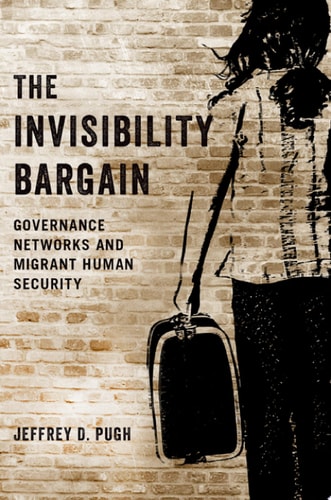
The Invisibility Bargain: Governance Networks and Migrant Human Security
0
0
As an Amazon Associate and affiliate partner, Menrva Books earns from qualifying purchases. Learn more
Author Description
Migrants fleeing economic hardship or violence are entitled to a range of protections and rights under domestic and international law, yet they are often denied such protections in practice. In an era of mass migration and restrictive responses, migrant acceptance is often contingent on the expectation that they contribute economically to the host country while remaining politically and socially invisible. These unwritten expectations, which Jeffrey D. Pugh calls the "invisibility bargain", produce a precarious status in which migrants' visible differences or overt political demands on the state may be met with hostile backlash from the host society. In this context, governance networks of state and non-state actors form an institutional web that can provide indirect access to rights, resources, and protection, but simultaneously help migrants avoid negative backlash against visible political activism. The Invisibility Bargain seeks to understand how migrants negotiate their place in receiving societies and adapt innovative strategies to integrate, participate, and access protection. Specifically, the book examines Ecuador, the largest recipient of refugees in Latin America, and assesses how it achieved migrant human security gains despite weak state presence in peripheral areas. Pugh deploys evidence from 15 months of fieldwork spanning ten years in Ecuador, including 170 interviews, an original survey of Colombian migrants in six provinces, network analysis, and discourse analysis of hundreds of presidential speeches and news media articles. He argues that localities with more dense networks composed of more diverse actors tend to produce greater human security for migrants and their neighbors. The book challenges the conventional understanding of migration and security, providing a new approach to the negotiation of authority between state and society. By examining the informal pathways to human security, Pugh dismantles the false dichotomy between international
Menrva's Summary
THE THESIS
This book investigates how governance networks between state and non-state actors facilitate migrant human security in environments where formal state protections are often absent or restrictive. Jeffrey D. Pugh, a scholar of international relations and migration, utilizes a decade of fieldwork in Ecuador to challenge traditional state-centric models of migrant integration. He argues that migrants often enter into an 'invisibility bargain,' trading political visibility for economic and social survival, and demonstrates how dense, diverse local networks provide the necessary infrastructure for security when national institutions fail.
THE SCOPE MAP
What You Will Find
- A comprehensive analysis of the 'invisibility bargain' framework within migration policy.
- Empirical data derived from 170 interviews and an original survey of Colombian migrants across six Ecuadorian provinces.
- A methodological approach combining network analysis with discourse analysis of presidential speeches and media coverage.
- Evidence-based findings on how local governance networks improve human security outcomes in peripheral regions.
THE AUTHORITY PERSPECTIVE
Experts in migration studies and Latin American politics identify this work as a significant contribution to the understanding of informal governance and human security. Readers frequently note the academic rigor of the methodology and the clarity with which the author navigates complex institutional webs.
Page Count:
295
Publication Date:
2021-01-01
Publisher:
Oxford University Press
ISBN-10:
0197538711
ISBN-13:
9780197538715
Migration Studies
Human security
Sociology
Human rights
Colombia
Public Policy
Comparative Politics
Refugees
Community Tags
Similar Books