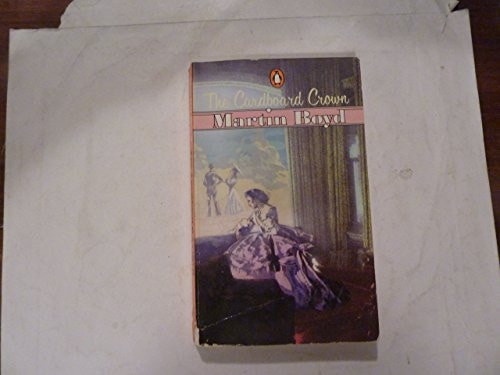
The Cardboard Crown
0
0
As an Amazon Associate and affiliate partner, Menrva Books earns from qualifying purchases. Learn more
Author Description
In "The cardboard crown" Mr Boyd returns to the theme of Lucinda Brayford. It is the story of an Australian woman of the last century whose need for the traditional civilisation of Europe draws her from her own country. Yet this continual attraction prevents her from taking root either in the Australian world in which she is socially pre-eminent, or in the English country home preserved from decay by the life-blood of her money; each excursion to Europe is paid for with tragedy and ends in retreat. The events and influences of her life: her elopement and marriage; an idyllic Roman interlude with a man who for her typifies European civilisation; the ironic sequel to this affair, are re-created long afterwards from a variety of sources: from her diary, in which passages of revealing emotion run like scars through its Victorian reticence; from the memories of those who knew her - notably Arthur, a colourful though not very reliable witness - and from fragments of family mythology and gossip. Each adds depth to the picture, and, in so doing, proves once again Mr Boyd's mastery at revealing the growth of character through experience.
Menrva's Summary
THE PULSE
The central conflict arises from Alice Langton's persistent, irreconcilable tension between her Australian roots and her idealized vision of European civilization. Alice seeks to anchor her identity within the traditional structures of Europe, yet her repeated attempts to transplant her life result in personal tragedy and social displacement. The narrative framework utilizes a non-linear approach, reconstructing Alice's life through the fragmented perspectives of her diary entries, family gossip, and the recollections of her relative, Arthur. These disparate accounts serve to examine the psychological cost of her social aspirations and the inevitable decay of the lifestyle she attempts to purchase.
INSIDE THE PAGES
- Use of an epistolary device through the inclusion of Alice's private diaries.
- Multi-perspective narrative structure incorporating family mythology and hearsay.
- Exploration of the cultural divide between colonial Australia and Victorian England.
- Character study focusing on the conflict between social status and personal fulfillment.
- Examination of the financial and emotional costs of maintaining an aristocratic facade.
- Integration of Roman settings to symbolize the protagonist's romanticized view of Europe.
- Unreliable narration provided by the character of Arthur.
- Thematic focus on the transience of identity across different geographic landscapes.
THE COLLECTIVE ECHO
Readers and critics frequently highlight the precision of Martin Boyd's prose in capturing the nuances of social class and cultural displacement. Discussion often centers on the effectiveness of the multi-layered narrative, which allows the reader to piece together Alice's character from conflicting accounts. Many observers note the balance between the atmospheric descriptions of European settings and the internal psychological development of the protagonist. The work is often praised for its ability to avoid sentimentality while exploring the tragic consequences of Alice's choices. Readers frequently point to the book's examination of family legacy as a primary driver of the narrative's enduring interest.
Page Count:
272
Publication Date:
1986-03-04
Publisher:
Penguin Books
ISBN-10:
0140069046
ISBN-13:
9780140069044
Historical Fiction
Literary Fiction
Literary
Genre Fiction
Historical
Classic fiction
Family Saga
Australian
Community Tags
Other Editions(6)



Similar Books







Reader Comments
Share Your Thoughts
No comments yet. Be the first to share your thoughts!