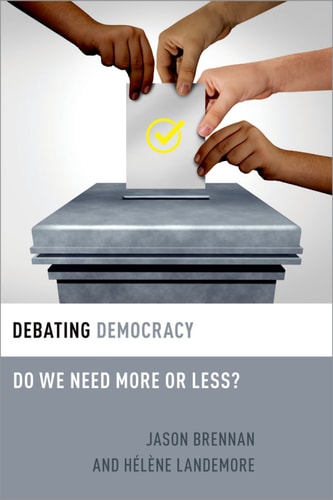
Debating Democracy: Do We Need More or Less?
0
0
As an Amazon Associate and affiliate partner, Menrva Books earns from qualifying purchases. Learn more
Author Description
Around the world, faith in democracy is falling. Russia, Turkey, and Venezuela have moved from flawed democracies to authoritarian regimes. Brexit and the rise of far-right parties show that even stable Western democracies are struggling. Partisanship and mutual distrust are increasing. What, if anything, should we do about these problems? In this accessible work, leading philosophers Jason Brennan and Hélène Landemore debate whether the solution lies in having less democracy or more. Brennan argues that democracy has systematic flaws, and that democracy does not and cannot work the way most of us commonly assume. He argues the best solution is to limit democracy's scope and to experiment with certain voting systems that can overcome democracy's problems. Landemore argues that democracy, defined as a regime that distributes power equally and inclusively, is a better way to generate good governance than oligarchies of knowledge. To her, the crisis of "representative democracy" comes in large part from its glaring democratic deficits. The solution is not just more democracy, but a better kind, which Landemore theorizes as "open democracy."
Menrva's Summary
THE THESIS
Does the current crisis of global democracy necessitate a reduction in democratic scope or an expansion toward more inclusive, open systems? Philosophers Jason Brennan and Hélène Landemore utilize their respective expertise in political theory to examine the systemic failures of modern governance. Brennan posits that democracy possesses inherent flaws that require restricted scope and alternative voting mechanisms, while Landemore argues that the solution lies in addressing democratic deficits through the implementation of open democracy.
THE SCOPE MAP
What You Will Find
- Comparative analysis of representative democracy versus open democracy models
- Evaluation of voting systems and their impact on governance quality
- Examination of global political trends including authoritarianism and rising partisanship
- Theoretical frameworks for distributing power and knowledge in political systems
THE AUTHORITY PERSPECTIVE
Experts identify this text as a significant contribution to contemporary political philosophy, noting its utility for students and scholars interested in democratic theory. Readers frequently highlight the clarity of the debate format, which allows for a balanced exploration of conflicting viewpoints on the future of governance.
Page Count:
296
Publication Date:
2021-01-01
Publisher:
Oxford University Press
ISBN-10:
0197540848
ISBN-13:
9780197540848
Politics
Philosophy
Comparative Politics
Ethics
Democracy
Community Tags
Similar Books