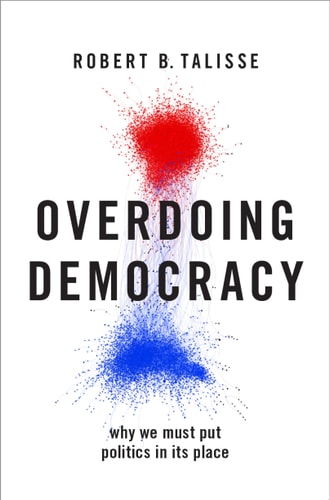
Overdoing Democracy: Why We Must Put Politics in its Place
0
0
As an Amazon Associate and affiliate partner, Menrva Books earns from qualifying purchases. Learn more
Author Description
We live in an age of political polarization. As political beliefs on the left and the right have been pulled closer to the extremes, so have our social environments: we seldom interact with those with whom we don't see eye to eye. Making matters worse, we are being appealed to--by companies, products, and teams, for example--based on our deep-seated, polarized beliefs. Our choice of Starbucks or Dunkin' Donuts, Costco or Sam's Club, soccer or football, New York Times vs. Wall Street Journal is an expression of our beliefs and a reinforcement of our choice to stay within the confines of our self-selected political community, making us even more polarized. Letting it bleed into these choices in every corner of our lives, we take democracy too far and it ends up keeping us apart. We overdo democracy.When we overdo democracy, we allow it to undermine and crowd out many of the most important social goods that democracy is meant to deliver. What's more, in overdoing democracy, we spoil certain social goods that democracy needs in order to flourish. A thriving democracy needs citizens to reserve space in their social lives for collective activities that are not structured by political allegiances. To ensure the health and the future of democracy, we need to forge civic friendships by working together in social contexts in which political affiliations and party loyalties are not merely suppressed, but utterly beside the point.Drawing on his extensive research, Talisse sheds light on just how deeply entrenched our political polarization has become and opens our eyes to how often we allow politics to dictate the way we see almost everything. By limiting our interactions with others and our experience of the world so that we only encounter the politically like-minded, we are actually damaging the thing that democracy is meant to preserve in the first place: the more fundamental good of recognizing and respecting each other's standing as equals.
Menrva's Summary
THE THESIS
This book investigates the paradox that excessive political engagement in non-political spheres of life is actively eroding the foundations of a healthy democratic society. Robert B. Talisse, a professor of philosophy and political science, utilizes research in social psychology and political theory to argue that the encroachment of partisan identity into everyday consumer and social choices creates echo chambers that undermine the mutual respect necessary for democratic function.
THE SCOPE MAP
What You Will Find
- Analysis of how political polarization influences consumer habits and social associations.
- A philosophical framework for the concept of civic friendship.
- Examination of the psychological mechanisms behind self-segregation into like-minded groups.
Scope Limits
- The text does not provide a comprehensive policy manual for legislative reform.
- It does not focus on international political systems outside of the Western democratic context.
THE AUTHORITY PERSPECTIVE
Scholars and political commentators frequently cite this work for its accessible yet rigorous philosophical critique of modern partisanship. Experts highlight the book as a significant contribution to the study of civic health and the necessity of non-political social spaces.
Page Count:
210
Publication Date:
2019-01-01
Publisher:
Oxford University Press
ISBN-10:
0190924225
ISBN-13:
9780190924225
Philosophy
Democracy
Sociology
Comparative Politics
Community Tags
Similar Books