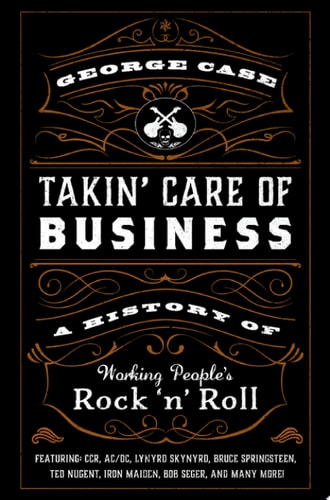
Takin' Care of Business: A History of Working People's Rock 'n' Roll
0
0
As an Amazon Associate and affiliate partner, Menrva Books earns from qualifying purchases. Learn more
Author Description
By the early 1970s, practically everyone under a certain age liked rock music, but not everyone liked it for the same reasons. We typically associate the sounds of classic rock 'n' roll with youthful rebellion by juvenile delinquents, student demonstrators, idealistic hippies, or irreverent punks. But in this insightful and timely book, author George Case shows how an important strain of rock music from the late 1960s onward spoke to — and represented an idealized self-portrait of — a very different audience: the working-class 'Average Joes' who didn't want to change the world as much as they wanted to protect their perceived place within it. To the extent that "working-class populism" describes an authentic political current, it's now beyond a doubt that certain musicians and certain of their songs helped define that current. By now, rock 'n' roll has cast a long shadow over hundreds of millions of people around the world — not just over reckless kids, but over wage-earning parents and retired elders; not just over indignant youth challenging authority, but over indignant adults challenging their own definition of it. Not only have the politics of rock fans drifted surprisingly rightward since 1970; some rock, as Case argues, has helped reset the very boundaries of left and right themselves. That God, guns, and Old Glory can be understood to be paid fitting tribute in a heavy guitar riff delivered by a long-haired reprobate in blue jeans — but that #Me Too, Occupy Wall Street or Black Lives Matter might not — hints at where those boundaries now lie.
Menrva's Summary
THE THESIS
How did rock music evolve from a symbol of youthful rebellion into a medium for working-class populism and conservative political identity? Author George Case examines the intersection of classic rock music and the socio-political values of the working-class demographic from the late 1960s to the present. By analyzing lyrical content and cultural reception, Case argues that specific strains of rock music helped define a populist political current that prioritizes traditional values and the preservation of social status over radical societal change.
THE SCOPE MAP
What You Will Find
- Analysis of the shift in rock music demographics from youth-centric rebellion to working-class adult identification.
- Examination of how rock music lyrics and aesthetics intersect with political themes like patriotism, religion, and labor.
- Case studies of specific artists and songs that resonate with working-class populism.
- Historical context on how rock music has influenced the modern political divide between left and right ideologies.
THE AUTHORITY PERSPECTIVE
Critics and readers recognize this work as a significant contribution to the study of music's role in shaping political identity. The text is noted for its ability to bridge the gap between music criticism and political sociology, providing a clear framework for understanding the rightward drift of certain rock fan bases.
Page Count:
211
Publication Date:
2021-01-01
Publisher:
Oxford University Press
ISBN-10:
0197548822
ISBN-13:
9780197548820
Music
Politics
History
American History
Rock music
Special Topics
Criticism history
Sociology
Humanities
Community Tags
Similar Books