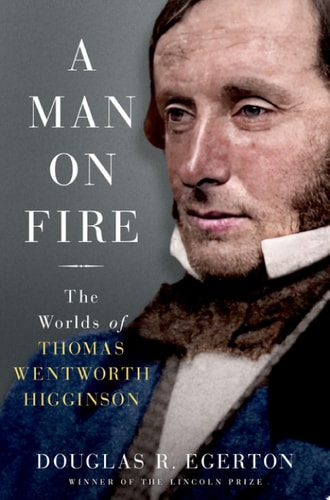
A Man on Fire: The Worlds of Thomas Wentworth Higginson
0
0
As an Amazon Associate and affiliate partner, Menrva Books earns from qualifying purchases. Learn more
Author Description
Few Americans covered as much ground as Thomas Wentworth Higginson. Born in 1823 to a family descended from Boston's Puritan founders, he attended Harvard, like all the men in his family, and prepared for the settled life of a minister. Instead, he rejected both privilege and convention, and embraced radical causes, attaching himself to nearly every major reform movement of the day, from women's rights to abolitionism. More than merely a fellow traveler, Higginson became a proponent of direct action. Wounded during an altercation with the police over an enslaved man who -in defiance of the Fugitive Slave Act-was fighting extradition to the South, Higginson wore the scar with pride. He became a member of Boston's Secret Six, supporting John Brown's raid and going to Bleeding Kansas with his rifle, prepared to put his life on the line. During the Civil War Higginson went to South Carolina and led one of the first Black regiments, the 1st Carolina Volunteers, into battle.Man of action though he was, "Colonel" Higginson was also a writer and journalist, friend of Ralph Waldo Emerson and Henry David Thoreau, and one of the founding editors of the Atlantic Magazine. Emily Dickinson sought out his advice and their correspondence attests both to Dickinson's genius and Higginson's attempt to help it reach a larger audience.Until his death in 1911, Higginson played a role, often a leading and vocal part, in nearly every progressive movement of the 19th century, earning a place in studies of abolitionism, feminism, education, temperance, Victorian fiction, as well as films, novels, and books featuring Dickinson and Harriet Tubman (whom he met in South Carolina during the Civil War). These reveal only aspects of Higginson's storied life. Douglas Egerton's biography embraces all the facets of this American whirlwind, illuminating the ways in which Higginson's lifelong crusade for a more just world resonates today.
Menrva's Summary
THE THESIS
This biography investigates the life and political evolution of Thomas Wentworth Higginson, a figure who bridged the gap between elite Bostonian intellectualism and radical direct action. Douglas R. Egerton, a historian specializing in the American South and the abolitionist movement, utilizes primary source documents, personal correspondence, and historical records to construct a comprehensive portrait of Higginson. The book argues that Higginson’s commitment to social reform—spanning abolitionism, women's rights, and education—was not merely peripheral but central to the progressive movements of the 19th century.
THE SCOPE MAP
What You Will Find
- Detailed accounts of Higginson’s involvement with the Secret Six and the raid on Harpers Ferry.
- Analysis of his leadership of the 1st South Carolina Volunteers during the Civil War.
- Examination of his literary contributions and his mentorship of Emily Dickinson.
- Exploration of his lifelong advocacy for women's suffrage and temperance.
THE AUTHORITY PERSPECTIVE
Historians and scholars recognize this work as a definitive account of a complex, often overlooked American reformer. Readers frequently note the meticulous research and the author's ability to contextualize Higginson’s radicalism within the broader Victorian landscape.
Page Count:
352
Publication Date:
2025-01-07
Publisher:
Oxford University Press
ISBN-10:
0197554059
ISBN-13:
9780197554050
History
Biography
Historical
Civil War
Americas
Abolitionism
19th Century
Social Activists
American History
Leaders & Notable People
Community Tags
Other Editions(4)

Similar Books




Reader Comments
Share Your Thoughts
No comments yet. Be the first to share your thoughts!