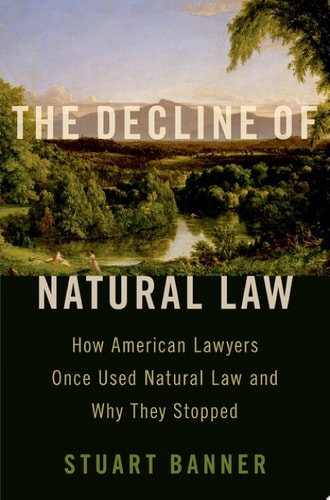
The Decline of Natural Law: How American Lawyers Once Used Natural Law and Why They Stopped
0
0
As an Amazon Associate and affiliate partner, Menrva Books earns from qualifying purchases. Learn more
Author Description
An account of a fundamental change in American legal thought, from a conception of law as something found in nature to one in which law is entirely a human creation.Before the late 19th century, natural law played an important role in the American legal system. Lawyers routinely used it in their arguments and judges often relied upon it in their opinions. Today, by contrast, natural law plays virtually no role in the legal system. When natural law was part of a lawyer's toolkit, lawyers thought of judges as finders of the law, but when natural law dropped out of the legal system, lawyers began thinking of judges as makers of the law instead.In The Decline of Natural Law, the eminent legal historian Stuart Banner explores the causes and consequences of this change. To do this, Banner discusses the ways in which lawyers used natural law and why the concept seemed reasonable to them. He further examines several long-term trends in legal thought that weakened the position of natural law, including the use of written constitutions, the gradual separation of the spheres of law and religion, the rapid growth of legal publishing, and the position of natural law in some of the 19th century's most contested legal issues. And finally, he describes both the profession's rejection of natural law in the late 19th and early 20th centuries and the ways in which the legal system responded to the absence of natural law.The first book to explain how natural law once worked in the American legal system, The Decline of Natural Law offers a unique look into how and why this major shift in legal thought happened, and focuses, in particular, on the shift from the idea that law is something we find to something we make.
Menrva's Summary
THE THESIS
This book investigates the historical transition in American jurisprudence from a framework based on natural law to one defined by legal positivism. Stuart Banner, a distinguished legal historian, utilizes primary source legal opinions and professional literature to trace how the perception of the judge's role shifted from a 'finder' of inherent law to a 'maker' of human-created statutes. The work argues that this transformation was not an abrupt event but the result of long-term structural changes in American society and the legal profession.
THE SCOPE MAP
What You Will Find
- Analysis of the 19th-century shift from natural law to legal positivism.
- Examination of the impact of written constitutions and the separation of law and religion.
- Evaluation of the influence of legal publishing growth on judicial reasoning.
- Case studies of contested legal issues that accelerated the decline of natural law.
THE AUTHORITY PERSPECTIVE
Legal scholars identify this work as a significant contribution to the understanding of American legal evolution. Experts frequently note the clarity of Banner's prose, which makes complex jurisprudential shifts accessible to both historians and legal practitioners.
Page Count:
263
Publication Date:
2021-01-01
Publisher:
Oxford University Press
ISBN-10:
0197556515
ISBN-13:
9780197556511
Philosophy
History
American History
Professional Career & Trade
Legal History
Law
Jurisprudence
Community Tags
Similar Books














