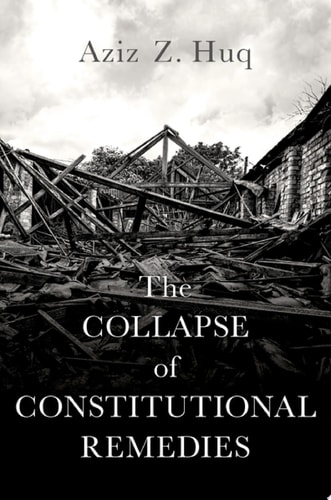
The Collapse of Constitutional Remedies (Inalienable Rights)
0
0
As an Amazon Associate and affiliate partner, Menrva Books earns from qualifying purchases. Learn more
Author Description
An exploration of how and why the Constitution's plan for independent courts has failed to protect individuals' constitutional rights, while advancing regressive and reactionary barriers to progressive regulation. Just recently, the Supreme Court rejected an argument by plaintiffs that police officers should no longer be protected by the doctrine of "qualified immunity" when they shoot or brutalize an innocent civilian. "Qualified immunity" is but one of several judicial inventions that shields state violence and thwarts the vindication of our rights. But aren't courts supposed to be protectors of individual rights? As Aziz Huq shows in The Collapse of Constitutional Remedies, history reveals a much more tangled relationship between the Constitution's system of independent courts and the protection of constitutional rights. While doctrines such as "qualified immunity" may seem abstract, their real-world harms are anything but. A highway patrol officer stops a person's car in violation of the Fourth Amendment, violently yanked the person out and threw him to the ground, causing brain damage. A municipal agency fires a person for testifying in a legal proceeding involving her boss's family-and then laughed in her face when she demanded her job back. In all these cases, state defendants walked away with the most minor of penalties (if any at all). Ultimately, we may have rights when challenging the state, but no remedies. In fact, federal courts have long been fickle and unreliable guardians of individual rights. To be sure, through the mid-twentieth century, the courts positioned themselves as the ultimate protector of citizens suffering the state's infringement of their rights. But they have more recently abandoned, and even aggressively repudiated, a role as the protector of individual rights in the face of abuses by the state. Ironically, this collapse highlights the position that the Framers took when setting up federal courts in the first place.
Menrva's Summary
THE THESIS
This book investigates the systemic failure of the American federal court system to provide meaningful remedies for constitutional rights violations. Aziz Z. Huq, a professor of law, utilizes historical analysis and contemporary legal case studies to argue that the judiciary has shifted from a protector of individual liberties to a mechanism that often shields state actors from accountability. He posits that the current state of constitutional law reflects a long-standing, often ignored tension between the Framers' original intent and the modern judicial application of doctrines like qualified immunity.
THE SCOPE MAP
What You Will Find
- Historical analysis of the evolution of federal court roles from the founding era to the present.
- Critical examination of legal doctrines such as qualified immunity that limit state accountability.
- Case studies involving police misconduct, municipal agency overreach, and Fourth Amendment violations.
- A theoretical framework explaining the divergence between having constitutional rights and possessing the legal means to enforce them.
THE AUTHORITY PERSPECTIVE
Legal scholars and practitioners recognize this work as a rigorous critique of modern judicial trends regarding civil rights enforcement. Readers frequently note the academic density of the prose, which serves as a foundational text for those analyzing the intersection of state power and judicial oversight.
Page Count:
192
Publication Date:
2021-01-01
Publisher:
Oxford University Press
ISBN-10:
0197556833
ISBN-13:
9780197556832
History
Civil Rights
United States
Constitutional Law
Professional Career & Trade
Law
Government
Community Tags
Similar Books