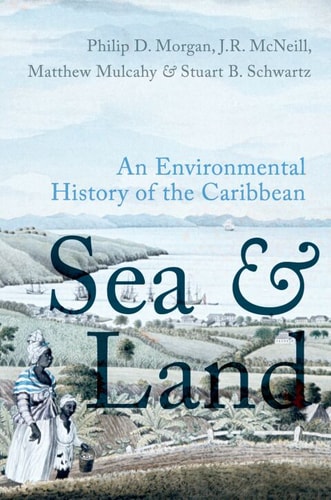
Sea and Land: An Environmental History of the Caribbean
0
0
As an Amazon Associate and affiliate partner, Menrva Books earns from qualifying purchases. Learn more
Author Description
Sea and Land provides an in-depth environmental history of the Caribbean to ca 1850, with a coda that takes the story into the modern era. It explores the mixing, movement, and displacement of peoples and the parallel ecological mixing of animals, plants, microbes from Africa, Europe, elsewhere in the Americas, and as far away as Asia. It examines first the arrival of Native American to the region and the environmental transformations that followed. It then turns to the even more dramatic changes that accompanied the arrival of Europeans and Africans in the fifteenth century. Throughout it argues that the constant arrival, dispersal, and mingling of new plants and animals gave rise to a creole ecology. Particular attention is given to the emergence of Black slavery, sugarcane, and the plantation system, an unholy trinity that thoroughly transformed the region's demographic and physical landscapes and made the Caribbean a vital site in the creation of the modern western world. Increased attention to issues concerning natural resources, conservation, epidemiology, and climate have now made the environment and ecology of the Caribbean a central historical concern. Sea and Land is an effort to integrate that research in a new general environmental history of the region. Intended for scholars and students alike, it aims to foster both a fuller appreciation of the extent to which environmental factors shaped historical developments in the Caribbean, and the extent to which human actions have transformed the biophysical environment of the region over time.The combined work of eminent authors of environment and Latin American and Caribbean history, Sea and Land offers a unique approach to a region characterized by Edenic nature and paradisiacal qualities, as well as dangers, diseases, and disasters.
Menrva's Summary
THE THESIS
This work investigates how the constant arrival, dispersal, and mingling of new species and human populations created a distinct 'creole ecology' that fundamentally shaped the Caribbean from the pre-colonial era to the modern day. The authors, a team of distinguished historians specializing in environmental and regional studies, synthesize extensive research to argue that the Caribbean served as a critical laboratory for the modern western world. By examining the intersection of human migration, the plantation system, and biological exchange, the text provides a comprehensive framework for understanding the region's physical and demographic transformation.
THE SCOPE MAP
What You Will Find
- A chronological analysis of environmental change from the arrival of Native Americans through the mid-19th century, with a modern-era coda.
- An examination of the 'unholy trinity' of Black slavery, sugarcane cultivation, and the plantation system.
- A study of the ecological impact of introduced plants, animals, and microbes from Africa, Europe, and Asia.
- An integration of research concerning natural resources, epidemiology, and climate history.
THE AUTHORITY PERSPECTIVE
Scholars and students of Caribbean history recognize this text as a significant synthesis of regional environmental change. Experts frequently highlight the authors' ability to balance broad ecological trends with the specific, often devastating, human impacts of colonial plantation economies.
Page Count:
458
Publication Date:
2022-01-01
Publisher:
Oxford University Press
ISBN-10:
0197555470
ISBN-13:
9780197555477
History
West Indies
American History
Modern History
Ecology
Caribbean Studies
Human ecology
Environmental History
Colonialism
Community Tags
Similar Books




Reader Comments
Share Your Thoughts
No comments yet. Be the first to share your thoughts!