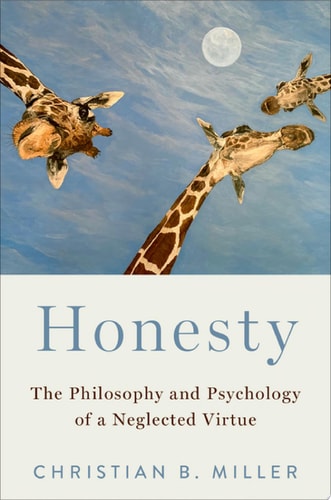
Honesty: The Philosophy and Psychology of a Neglected Virtue
0
0
As an Amazon Associate and affiliate partner, Menrva Books earns from qualifying purchases. Learn more
Author Description
Honesty is an important virtue. Parents want to develop it in their children. Close relationships depend upon it. Employers value it in their employees. Surprisingly, however, philosophers have said very little about the virtue of honesty over the past fifty years. In this book, Christian B. Miller aims to draw much greater attention to this neglected virtue. The first part of the book looks at the concept of honesty. It takes up questions such as: What does honesty involve? What are the motives of an honest person? How does practical wisdom relate to honesty? Miller explores what connects the many sides of honesty, including not lying, not stealing, not breaking promises, not misleading others, and not cheating. He argues that the honest person reliably does not intentionally distort the facts as she takes them to be. Miller then examines the empirical psychology of honesty. He takes up the question of whether most people are honest, dishonest, or somewhere in between. Drawing extensively on recent studies of cheating and lying, the model Miller articulates ultimately implies that most of us have a long way to go to reach an honest character. Honesty: The Philosophy and Psychology of a Neglected Virtue provides both a richer understanding of what our character looks like, as well as what the goal of being an honest person actually involves. Miller then leaves it up to us to decide if we want to take steps to shrink the character gap between the two.
Menrva's Summary
THE THESIS
What constitutes the virtue of honesty, and how does the reality of human behavior align with our moral ideals? Christian B. Miller, a philosopher specializing in character and virtue ethics, synthesizes philosophical inquiry with empirical psychological data to define honesty. He argues that while honesty is a foundational social value, modern discourse has largely neglected its conceptual framework, leaving a significant gap between our perceived character and our actual conduct.
THE SCOPE MAP
What You Will Find
- A conceptual analysis of honesty, including its relationship to truth-telling, promise-keeping, and integrity.
- An examination of the motives and practical wisdom required for an honest character.
- A review of empirical psychological studies regarding human tendencies toward cheating and lying.
- A critical assessment of the 'character gap' between human behavior and the ideal of an honest person.
THE AUTHORITY PERSPECTIVE
Experts recognize this work as a significant contribution to contemporary virtue ethics, particularly for its integration of experimental psychology with traditional philosophical inquiry. Readers often note the text's rigorous approach to defining moral character, making it a valuable resource for those interested in the intersection of ethics and behavioral science.
Page Count:
329
Publication Date:
2021-01-01
Publisher:
Oxford University Press
ISBN-10:
0197567517
ISBN-13:
9780197567517
Psychology
Philosophy
Non-Fiction
Ethics
Mind & Body
Honesty
Community Tags
Similar Books