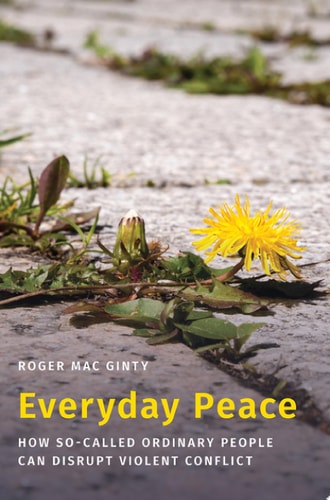
Everyday Peace: How So-called Ordinary People Can Disrupt Violent Conflict
0
0
As an Amazon Associate and affiliate partner, Menrva Books earns from qualifying purchases. Learn more
Author Description
An exploration of how so-called ordinary people can disrupt violent conflict and forge peace.In this pathbreaking book, Roger Mac Ginty explores everyday peace-or how individuals and small groups can eke out spaces of tolerance and conciliation in conflict-ridden societies. Drawing on original material from the Everyday Peace Indicators project, he blends theory and concept-building together with contemporary and comparative examples. Unusual for the disciplines of peace and conflict studies as well as international relations, Everyday Peace also utilizes personal diaries and memoirs from World Wars One and Two. The book unpacks the core components of everyday peace and argues that it is constructed from a mix of sociality, reciprocity, and solidarity. This exploration of bottom-up and community-level approaches to peace challenges the usual concentration on top-down approaches to peace advanced by governments and international organizations. Indeed, the book goes to the lowest level of social organization - individuals, families and small groups of friends and colleagues - and looks at everyday interaction in workplaces, the stairwells of apartment buildings, and the queue for public transport.Mac Ginty sees peace and conflict as being embodied, lived, and experienced - and constructs a multi-layered definition of peace. Importantly, he applies his evidentiary base of micro-acts that constitute everyday peace to societies that have emerged out of conflict and have not experienced recidivism on a large scale. Unlike most who focus on top-down processes, he demonstrates that what matters is the interaction between top-down and bottom-up peace and how, in an ideal scenario, they can have a symbiotic relationship. By focusing on how the small-scale can have big and lasting effects, Everyday Peace will reshape our understanding of how peace comes about.
Menrva's Summary
THE THESIS
This book investigates how individual, small-scale social interactions can effectively disrupt violent conflict and foster sustainable peace in divided societies. Roger Mac Ginty, a professor specializing in peace and conflict studies, utilizes data from the Everyday Peace Indicators project alongside historical memoirs to challenge the traditional focus on top-down diplomatic interventions. He argues that peace is fundamentally constructed through micro-acts of sociality, reciprocity, and solidarity occurring at the community level. By examining the intersection of bottom-up initiatives and institutional frameworks, the author provides a new lens for understanding how peace is lived and maintained in post-conflict environments.
THE SCOPE MAP
What You Will Find
- Analysis of micro-level social interactions in workplaces, residential buildings, and public transit.
- Integration of personal diaries and memoirs from World War One and World War Two.
- Methodology derived from the Everyday Peace Indicators project.
- Theoretical framework for the symbiotic relationship between top-down and bottom-up peacebuilding.
THE AUTHORITY PERSPECTIVE
Experts in the field of peacebuilding recognize this work as a significant shift toward micro-sociological analysis in international relations. Readers frequently note the accessibility of the prose despite its academic rigor, highlighting its utility for both scholars and practitioners interested in community-level conflict resolution.
Page Count:
272
Publication Date:
2021-01-01
Publisher:
Oxford University Press
ISBN-10:
0197563414
ISBN-13:
9780197563410
Politics
Comparative Politics
Specific Topics
Peace studies
Technology & Engineering
Sociology
International relations
Trades & Technology
Conflict Resolution
Systems Theory
Community Tags
Similar Books