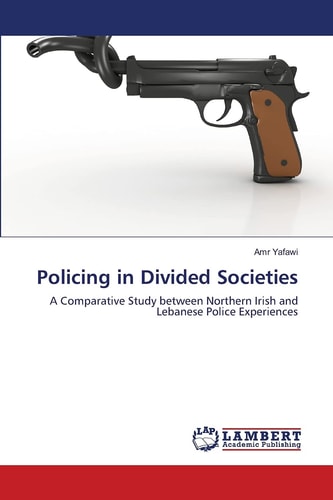
Policing in Divided Societies
0
0
As an Amazon Associate and affiliate partner, Menrva Books earns from qualifying purchases. Learn more
Author Description
This book compares models of policing in divided societies as applied in Lebanon and Northern Ireland and highlights the advantages and disadvantages of each. Comparative public opinion data from both countries are collected and analyzed. Results suggest that enhancing public confidence in Lebanese police force and strengthening positive public perception in the country's law enforcement agencies require strong communal interventions.Lessons drawn from the Northern Irish experience and analysis of Lebanese public opinion data suggest that in a post-conflict situation Community Oriented Policing (COP) needs to be combined with Problem Oriented Policing (POP) as a transitional approach that can strengthen community-police relations. This conclusion has been further confirmed by a series of interviews completed with chief police officers in both countries. The suggested recommendations should be especially helpful for police officers, politicians, government personnel or anyone else considering being a part of the reconciliation process in his country.
Menrva's Summary
THE THESIS
This book investigates the effectiveness of policing models in societies fractured by deep divisions. It examines the application of these models in Lebanon and Northern Ireland, detailing the strengths and weaknesses of each approach. The analysis incorporates comparative public opinion data from both nations, suggesting that robust community interventions are crucial for building public confidence in the Lebanese police force. The work draws lessons from Northern Ireland's experience to propose a combined Community Oriented Policing (COP) and Problem Oriented Policing (POP) strategy as a transitional method for post-conflict reconciliation.
THE SCOPE MAP
- Comparative analysis of policing models in Lebanon and Northern Ireland.
- Collection and analysis of comparative public opinion data from both countries.
- Examination of the advantages and disadvantages of different policing strategies.
- Focus on community interventions to enhance public confidence in law enforcement.
- Proposal of a combined Community Oriented Policing (COP) and Problem Oriented Policing (POP) approach for post-conflict situations.
- Insights from interviews with chief police officers in Lebanon and Northern Ireland.
- Recommendations for police officers, politicians, and government personnel involved in reconciliation processes.
THE AUTHORITY PERSPECTIVE
The book presents a comparative study of policing in divided societies, focusing on Lebanon and Northern Ireland. It utilizes public opinion data and interviews with police officers to analyze the effectiveness of various policing models. The research suggests that a combination of Community Oriented Policing and Problem Oriented Policing is beneficial in post-conflict environments for strengthening community-police relations. The findings offer practical recommendations for stakeholders involved in national reconciliation efforts.
Page Count:
136
Publication Date:
2013-01-01
Publisher:
Lap Lambert Academic Publishing GmbH KG
ISBN-10:
3659483346
ISBN-13:
9783659483349
Psychology
Politics
Non-Fiction
Sociology
Comparative Politics
Law Enforcement
Conflict Resolution
Community Tags
Similar Books