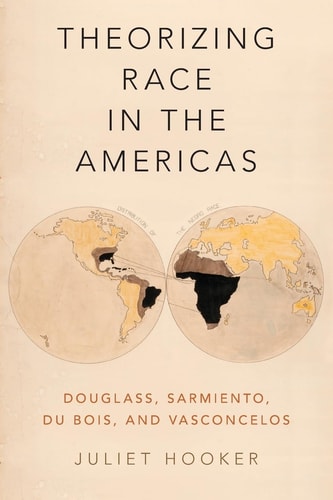
Theorizing Race in the Americas: Douglass, Sarmiento, Du Bois, and Vasconcelos
0
0
As an Amazon Associate and affiliate partner, Menrva Books earns from qualifying purchases. Learn more
Author Description
In 1845 two thinkers from the American hemisphere--the Argentinean statesman Domingo Faustino Sarmiento, and the fugitive ex-slave, abolitionist leader, and orator from the United States, Frederick Douglass--both published their first works. Each would become the most famous and enduring texts in what were both prolific careers, and they ensured Sarmiento and Douglass' position as leading figures in the canon of Latin American and U.S. African-American political thought, respectively. But despite the fact that both deal directly with key political and philosophical questions in the Americas, Douglass and Sarmiento, like African-American and Latin American thought more generally, are never read alongside each other. This may be because their ideas about race differed dramatically. Sarmiento advocated the Europeanization of Latin America and espoused a virulent form of anti-indigenous racism, while Douglass opposed slavery and defended the full humanity of black persons. Still, as Juliet Hooker contends, looking at the two together allows one to chart a hemispheric intellectual geography of race that challenges political theory's preoccupation with and assumptions about East/West comparisons, and questions the use of comparison as a tool in the production of theory and philosophy.By juxtaposing four prominent nineteenth and twentieth-century thinkers--Frederick Douglass, Domingo F. Sarmiento, W. E. B. Du Bois, and José Vasconcelos--her book will be the first to bring African-American and Latin American political thought into conversation. Hooker stresses that Latin American and U.S. ideas about race were not developed in isolation, but grew out of transnational intellectual exchanges across the Americas. In so doing, she shows that nineteenth and twentieth-century U.S. and Latin American thinkers each looked to political models in the "other" America to advance racial projects in their own countries. Reading these four intellectuals hemispheric thinkers, Hooker foregr
Menrva's Summary
THE THESIS
How can a comparative analysis of hemispheric political thought reshape our understanding of racial ideologies in the Americas? Juliet Hooker, a scholar of political theory, investigates the intellectual exchanges between the United States and Latin America by examining the works of Frederick Douglass, Domingo F. Sarmiento, W. E. B. Du Bois, and José Vasconcelos. She argues that these thinkers did not develop their racial theories in isolation but rather through transnational dialogues, using political models from the 'other' America to inform their own national projects.
THE SCOPE MAP
What You Will Find
- Comparative analysis of 19th and 20th-century political texts from the U.S. and Latin America.
- Examination of the intellectual influence of Sarmiento and Vasconcelos alongside Douglass and Du Bois.
- Analysis of how racial projects were constructed through hemispheric intellectual geography.
Scope Limits
- The text focuses primarily on the specific political philosophies of these four figures rather than a comprehensive history of all racial movements in the Americas.
THE AUTHORITY PERSPECTIVE
Scholars frequently cite this work as a significant intervention in political theory for its rejection of traditional East/West comparative frameworks. Experts highlight the text for its rigorous methodology in bridging the often-siloed fields of African American and Latin American intellectual history.
Page Count:
296
Publication Date:
2019-04-01
Publisher:
Oxford University Press
ISBN-10:
0190055863
ISBN-13:
9780190055868
History
Philosophy
Politics
Politics & Government
Race Studies
Cultural
New Used & Rental Textbooks
Ethnic Studies
United States
Race Relations
Anthropology
American Studies
Social Philosophy
Comparative Politics
Systems Theory
Political
African American
Community Tags
Similar Books