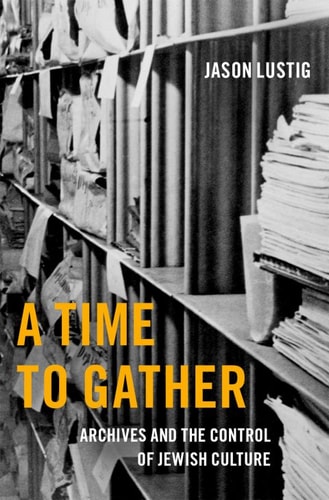
A Time to Gather: Archives and the Control of Jewish Culture
0
0
As an Amazon Associate and affiliate partner, Menrva Books earns from qualifying purchases. Learn more
Author Description
How do people link the past to the present, marking continuity in the face of the fundamental discontinuities of history? A Time to Gather argues that historical records took on potent value in modern Jewish life as both sources of history and anchors of memory because archives presented one way of transmitting Jewish history from one generation to another as well as making claims of access to an "authentic" Jewish culture. Indeed, both before the Holocaust and especially in its aftermath, Jewish leaders around the world felt a shared imperative to muster the forces and resources of Jewish life. It was a "time to gather," a feverish era of collecting-and conflict-in which archive-making was both a response to the ruptures of modernity, and a mechanism for communities to express their cultural hegemony.Jason Lustig explores how archives became battlegrounds over control of Jewish culture from the turn of the twentieth century to the cusp of the digital era. He excavates a tradition of monumental collecting, represented by repositories like the Gesamtarchiv der deutschen Juden, the German Jews' central archive formed in Berlin in 1903, alongside the Central Archives for the History of the Jewish People in Jerusalem and the American Jewish Archives in Cincinnati, both opened in 1947, which all showcase the continual struggle over "owning" the Jewish past. Lustig presents archive-making as an organizing principle of twentieth-century Jewish culture, as a metaphor of great power and broad symbolic meaning with the dispersion and gathering of documents falling in the context of the Jews' long diasporic history. In this light, creating archives was just as much about the future as it was about the past.
Menrva's Summary
THE THESIS
This book investigates how the systematic collection of historical records became a central mechanism for defining, controlling, and transmitting Jewish culture amidst the ruptures of the twentieth century. Jason Lustig, a scholar of modern Jewish history, utilizes archival records and institutional histories to argue that the act of gathering documents served as both a response to historical discontinuity and a method for establishing cultural authority. By examining the development of major repositories in Berlin, Jerusalem, and Cincinnati, the author demonstrates that the creation of archives was a forward-looking project designed to secure the future of Jewish identity through the ownership of the past.
THE SCOPE MAP
What You Will Find
- A historical analysis of major Jewish archival institutions including the Gesamtarchiv der deutschen Juden and the American Jewish Archives.
- An examination of the tension between diaspora dispersion and the centralized gathering of cultural artifacts.
- A study of the political and social conflicts surrounding the ownership and control of Jewish historical narratives.
- A framework for understanding archive-making as an organizing principle of modern Jewish cultural life.
THE AUTHORITY PERSPECTIVE
Scholars and historians recognize this work as a significant contribution to the study of archival science and Jewish cultural history. Readers frequently note the meticulous research and the author's ability to connect institutional development with broader themes of memory and identity.
Page Count:
275
Publication Date:
2021-01-01
Publisher:
Oxford University Press
ISBN-10:
0197563546
ISBN-13:
9780197563540
History
Religion
Archives
Asia history
Modern History
Jewish History
European History
Judaism
Special Topics
Jewish Studies
Cultural History
Community Tags
Other Editions(3)
Similar Books






Reader Comments
Share Your Thoughts
No comments yet. Be the first to share your thoughts!