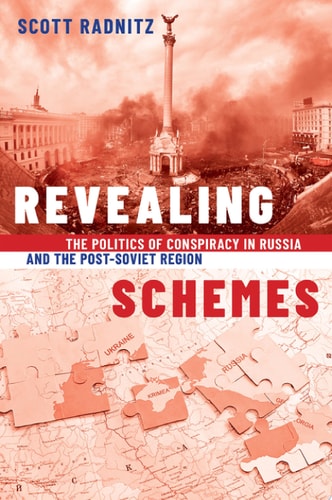
Revealing Schemes: The Politics of Conspiracy in Russia and the Post-Soviet Region
0
0
As an Amazon Associate and affiliate partner, Menrva Books earns from qualifying purchases. Learn more
Author Description
Conspiracy theories are not just outlandish ideas. They can also be political weapons. Conspiracy theories have come to play an increasingly prominent role in political systems around the world. In Revealing Schemes, Scott Radnitz moves beyond psychological explanations for why people believe conspiracy theories to explore the politics surrounding them, placing two questions at the center of his account: What leads regimes to promote conspiracy claims? And what effects do those claims have on politics and society? Focusing on the former Soviet Union—a region of the world where such theories have long thrived—he shows that incumbent politicians tend to make conspiracy claims to demonstrate their knowledge and authority at moments of uncertainty and threat. They emerge more often where there is serious political competition rather than unbridled autocracy and in response to events that challenge a regime's ability to rule. Yet conspiracy theories can also be habit-forming and persist as part of an official narrative even where immediate threats have subsided—a strategy intended to strengthen regimes, but that may inadvertently undermine them. Revealing Schemes explores the causes, consequences, and contradictions of conspiracism in politics with an original collection of over 1,500 conspiracy claims from across the post-Soviet region, two national surveys, and 12 focus groups. At a time of heightened distrust in democratic institutions and rising illiberal populism around the world, understanding how conspiracy theories operate in a region where democracy came late—or never arrived—can be instructive for concerned citizens everywhere.
Menrva's Summary
THE THESIS
This book investigates the strategic utility of conspiracy theories as political instruments employed by regimes within Russia and the post-Soviet region. Scott Radnitz, a scholar specializing in post-Soviet politics, utilizes a robust dataset of over 1,500 conspiracy claims to argue that incumbent politicians deploy these narratives to project authority and manage perceptions of threat during periods of instability. The work challenges purely psychological interpretations of conspiracism, instead framing it as a calculated, albeit risky, tool of statecraft that can paradoxically weaken the very regimes it is intended to protect.
THE SCOPE MAP
What You Will Find
- An original dataset comprising over 1,500 documented conspiracy claims from across the post-Soviet region.
- Analysis of two national surveys and 12 focus groups designed to gauge public reception and the impact of state-sponsored narratives.
- A comparative framework examining the prevalence of conspiracy claims in competitive regimes versus stable autocracies.
- An exploration of the long-term consequences of institutionalizing conspiracism as a standard component of official state rhetoric.
THE AUTHORITY PERSPECTIVE
Experts recognize this work as a significant contribution to the study of illiberal populism and political communication in authoritarian contexts. Readers frequently note the clarity of the author's methodology and the relevance of his findings to broader global trends in political distrust.
Page Count:
258
Publication Date:
2021-01-01
Publisher:
Oxford University Press
ISBN-10:
0197573568
ISBN-13:
9780197573563
History
Conspiracy theories
Sociology
Russia
European History
International relations
Community Tags
Similar Books