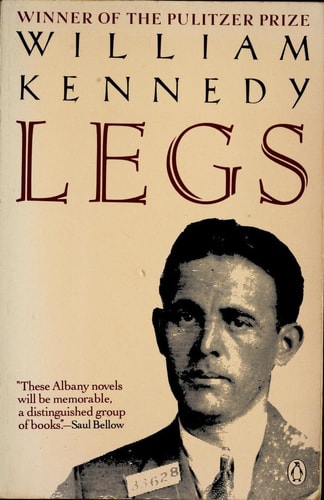
Legs
0
0
As an Amazon Associate and affiliate partner, Menrva Books earns from qualifying purchases. Learn more
Author Description
The Pulitzer Prize-winning author of Ironweed explores an era of American innocene and corruption in the first novel in his Albany cycle.“The best novel about a criminal legend I've ever read.”—Hunter S. ThompsonTrue to both life and legend, Legs brilliantly evokes the flamboyant career of gangster Jack “Legs” Diamond. Through the equivocal eyes of Diamond’s attorney, Marcus Gorman (who scraps a promising political career for the more elemental excitement of the criminal underworld), we watch as Legs and his showgirl mistress, Kiki Roberts, blaze their gaudy trail across the tabloid pages of the 1920s and 1930s.William Kennedy’s Albany Cycle of novels reflect what he once described as the fusion of his imagination with a single place. A native and longtime resident of Albany, New York, his work moves from the mid-nineteenth to the mid-twentieth century, chronicling family life, the city’s netherworld, and its spheres of power—financial, ethnic, political—often among the Irish-Americans who dominated the city in this period. The novels in his cycle include, Legs, Billy Phelan’s Greatest Game, Ironweed, Quinn’s Book, Very Old Bones, The Flaming Corsage, and Roscoe.
Menrva's Summary
THE PULSE
The narrative centers on the rise and inevitable decline of notorious Prohibition-era gangster Jack "Legs" Diamond as observed through the perspective of his legal counsel. Marcus Gorman, a lawyer who abandons his conventional political ambitions, becomes captivated by the volatile lifestyle of Diamond and his mistress, Kiki Roberts. The story operates as a character study of a criminal icon, utilizing Gorman's retrospective narration to examine the intersection of celebrity, violence, and the moral decay of the 1920s and 1930s. The world is defined by the rigid hierarchies of the underworld and the shifting political landscape of Albany, New York.
INSIDE THE PAGES
- First-person retrospective narration by Marcus Gorman
- Exploration of the intersection between criminal legend and historical reality
- Detailed depiction of the Prohibition era in New York
- Focus on the psychological motivations of a career criminal
- Examination of the symbiotic relationship between the press and the underworld
- Atmospheric portrayal of Albany as a central character
- Integration of real-life figures alongside fictionalized perspectives
- Thematic focus on the allure of power and the cost of moral compromise
THE COLLECTIVE ECHO
Readers and critics frequently note the stylistic precision with which Kennedy captures the cadence of the era. Discussion often centers on the effectiveness of using a secondary character like Gorman to maintain a sense of distance from the protagonist's violent actions. Many highlight the balance between the gritty reality of criminal life and the myth-making process inherent in tabloid journalism. The prose is often praised for its ability to ground historical figures in a specific, tangible setting without relying on excessive sentimentality. This work is widely regarded as a foundational entry in the author's broader exploration of the American urban experience.
Page Count:
320
Publication Date:
1983-01-27
Publisher:
Penguin Books
ISBN-10:
0140064842
ISBN-13:
9780140064841
Literary Fiction
Historical Fiction
Crime
United States
Literary
Custom Stores
Genre Fiction
Self Service
Historical
Biographical fiction
Mystery Thriller & Suspense
Crime
American