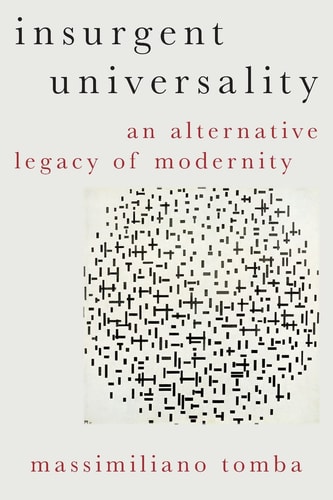
Insurgent Universality: An Alternative Legacy of Modernity
0
0
As an Amazon Associate and affiliate partner, Menrva Books earns from qualifying purchases. Learn more
Author Description
Scholars commonly take the Declaration of the Rights of Man and Citizen of 1789, written during the French Revolution, as the starting point for the modern conception of human rights. According to the Declaration, the rights of man are held to be universal, at all times and all places. But as recent crises around migrants and refugees have made obvious, this idea, sacred as it might be among human rights advocates, is exhausted. It's long past time to reconsider the principles on which Western economic and political norms rest.This book advocates for a tradition of political universality as an alternative to the juridical universalism of the Declaration. Insurgent universality isn't based on the idea that we all share some common humanity but, rather, on the democratic excess by which people disrupt and reject an existing political and economic order. Going beyond the constitutional armor of the representative state, it brings into play a plurality of powers to which citizens have access, not through the funnel of national citizenship but in daily political practice. We can look to recent history to see various experiments in cooperative and insurgent democracy: the Indignados in Spain, the Arab Spring, Occupy, the Zapatistas in Mexico, and, going further back, the Paris Commune, the 1917 peasant revolts during the Russian Revolution, and the Haitian Revolution. This book argues that these movements belong to the common legacy of insurgent universality, which is characterized by alternative trajectories of modernity that have been repressed, hindered, and forgotten. Massimiliano Tomba examines these events to show what they could have been and what they can still be. As such he explores how their common legacy can be reactivated. Insurgent Universality analyzes the manifestos and declarations that came out of these experiments considering them as collective works of an alternative canon of political theory that challenges the great names of the Western pantheon of political thought.
Menrva's Summary
THE THESIS
This book investigates whether an alternative tradition of political universality can be recovered from historical movements that have been repressed or forgotten by mainstream Western modernity. Massimiliano Tomba, a scholar of political theory, challenges the conventional reliance on the 1789 Declaration of the Rights of Man and Citizen. He argues that current juridical universalism is exhausted and proposes a framework of 'insurgent universality' rooted in democratic excess and the active disruption of existing political and economic orders.
THE SCOPE MAP
What You Will Find
- A comparative analysis of historical insurgent movements including the Haitian Revolution, the Paris Commune, and the Arab Spring.
- A critique of the constitutional limitations inherent in the modern representative state.
- An examination of manifestos and declarations from grassroots democratic experiments as a counter-canon of political theory.
- A methodology for reactivating forgotten political trajectories to inform contemporary democratic practice.
THE AUTHORITY PERSPECTIVE
Experts in political philosophy identify this work as a significant contribution to the critique of liberal constitutionalism and human rights discourse. Readers frequently note the academic density of the prose, which requires familiarity with continental political theory to fully grasp the author's arguments.
Page Count:
300
Publication Date:
2021-03-01
Publisher:
Oxford University Press
ISBN-10:
0197577237
ISBN-13:
9780197577233
Philosophy
History
Political Theory
Modernity
Community Tags
Other Editions(2)
Similar Books

Reader Comments
Share Your Thoughts
No comments yet. Be the first to share your thoughts!