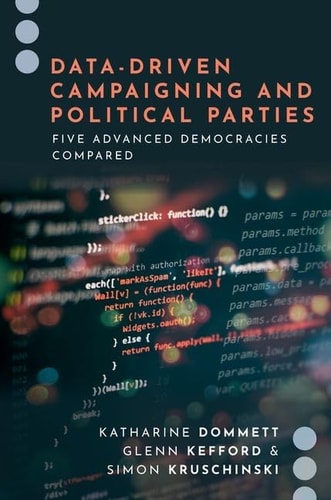
Data-Driven Campaigning and Political Parties: Five Advanced Democracies Compared
0
0
As an Amazon Associate and affiliate partner, Menrva Books earns from qualifying purchases. Learn more
Author Description
What is data-driven campaigning? According to prevailing accounts, this idea describes the rise of increasingly sophisticated, highly targeted, and often invasive uses of data deployed to suppress votes, manipulate voter preferences, or boost a candidates' popularity. The power of data is seen to be transforming campaigning practice and raising democratic concerns. And yet, there is a significant problem with these ideas: we have at best a partial understanding of how data-driven campaigning is practiced, and limited clarity about its implications.Presenting data from interviews with over 300 professional campaigners in Australia, Canada, Germany, the UK and US, we provide unique insight into the components of data-driven campaigning by political parties. This book makes three key contributions. First, distinguishing between data, analytics, technology and personnel, they give unmatched descriptive insight into these four components of data-driven campaigning, revealing significant variation in its operationalization, depending on party and country context. Second, introducing a novel multi-level theoretical framework, they isolate systemic, regulatory, and party level variables that help explain the reasons for these differences. Third, they consider the implications of their findings for debates about democracy, data and technology in the 21st century.Cumulatively, these contributions reveal that data-driven campaigning is not inherently problematic. Giving voice to practitioner perspectives, through interviews and innovative vignettes, this book recasts the debate around data-driven campaigning, offering important lessons for scholars, campaigners, and policymakers alike.
Menrva's Summary
THE THESIS
This book investigates the actual mechanics and democratic implications of data-driven campaigning by analyzing how political parties in five advanced democracies utilize technology and information. The authors, Glenn Kefford, Katharine Dommett, and Simon Kruschinski, draw upon extensive primary research, including interviews with over 300 professional political campaigners. They challenge prevailing narratives that suggest data-driven campaigning is inherently manipulative, instead proposing a multi-level theoretical framework that accounts for systemic, regulatory, and party-specific variables to explain how these practices vary across different national contexts.
THE SCOPE MAP
What You Will Find
- Comparative analysis of political campaigning in Australia, Canada, Germany, the UK, and the US.
- A multi-level theoretical framework isolating systemic, regulatory, and party-level variables.
- Empirical data derived from over 300 interviews with professional political practitioners.
- A breakdown of the four core components of campaigning: data, analytics, technology, and personnel.
THE AUTHORITY PERSPECTIVE
Experts identify this work as a significant empirical contribution to the study of political communication and digital democracy. Readers frequently note the clarity of the authors' comparative framework, which provides a necessary corrective to speculative discourse regarding the influence of data in modern elections.
Page Count:
254
Publication Date:
2024-01-01
Publisher:
Oxford University Press
ISBN-10:
0197570224
ISBN-13:
9780197570227
Politics
Elections & Political Process
Data Science
Technology
Government
Communication
Specific Topics
Sociology
Community Tags
Similar Books