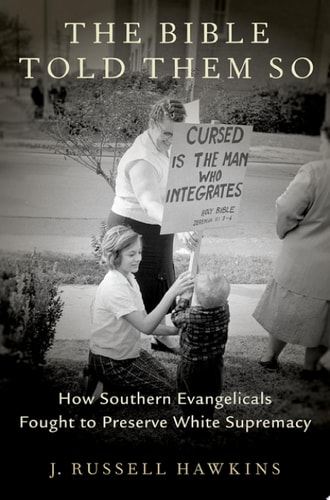
The Bible Told Them So: How Southern Evangelicals Fought to Preserve White Supremacy
0
0
As an Amazon Associate and affiliate partner, Menrva Books earns from qualifying purchases. Learn more
Author Description
Why did southern white evangelical Christians resist the civil rights movement in the 1950s and 1960s? Simply put, they believed the Bible told them so. These white Christians entered the battle certain that God was on their side. Ultimately, the civil rights movement triumphed in the 1960s and, with its success, fundamentally transformed American society. But this victory did little to change southern white evangelicals' theological commitment to segregation. Rather than abandoning their segregationist theology in the second half of the 1960s, white evangelicals turned their focus on institutions they still controlled--churches, homes, denominations, and private colleges and secondary schools--and fought on. Focusing on the case of South Carolina, The Bible Told Them So shows how, despite suffering defeat in the public sphere, white evangelicals continued to battle for their own institutions, preaching and practicing a segregationist Christianity they continued to believe reflected God's will. Increasingly caught in the tension between their sincere belief that God desired segregation and their reluctance to give voice to such ideas for fear of being perceived as bigoted or intolerant, by the late 1960s southern white evangelicals embraced the rhetoric of colorblindness and protection of the family as measures to maintain both segregation and respectable social standing. This strategy set southern white evangelicals on an alternative path for race relations in the decades ahead.
Menrva's Summary
THE THESIS
This book investigates how southern white evangelical Christians utilized theological justifications to resist the civil rights movement and maintain segregationist structures throughout the mid-twentieth century. J. Russell Hawkins, a scholar of American religious history, examines the intersection of faith and racial politics in the American South. By analyzing the transition from overt segregationist rhetoric to the adoption of colorblind ideology, the author demonstrates how these religious communities preserved their social and institutional power despite the broader societal shifts of the 1960s.
THE SCOPE MAP
What You Will Find
- A detailed case study focusing on the state of South Carolina during the 1950s and 1960s.
- An analysis of how private religious institutions, including schools and denominations, were used to circumvent integration.
- Examination of primary source documents, sermons, and institutional records from evangelical organizations.
- A historical framework explaining the shift toward the rhetoric of colorblindness and family protection as a means of maintaining social status.
THE AUTHORITY PERSPECTIVE
Scholars and historians recognize this work as a significant contribution to the study of American evangelicalism and its complex relationship with racial politics. Readers frequently note the clarity with which the author connects theological conviction to the preservation of institutional segregation.
Page Count:
222
Publication Date:
2021-01-01
Publisher:
Oxford University Press
ISBN-10:
0197571077
ISBN-13:
9780197571071
Religion
History
Christianity
World Civilization
Sociology
Civil Rights
American History
Ethnic Studies
Special Topics
Community Tags
Similar Books














