Framboids
0
0
As an Amazon Associate and affiliate partner, Menrva Books earns from qualifying purchases. Learn more
Author Description
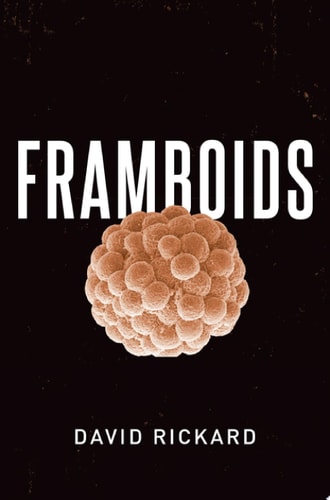
Framboids may be the most astonishing and abundant natural features you've never heard of. These microscopic spherules of golden pyrite consist of thousands of even smaller microcrystals, often arranged in stunning geometric arrays. They are rarely more than twenty micrometers across, and often look like miniscule raspberries under the microscope. The formation of a framboid is the result of self-assembly of pyrite micro- and nano-crystals under the influence of surface forces. They can be found all around us in rocks of all ages and present-day sediments, soils, and natural waters. Our planet makes billions every second and has been doing so for most of recorded geologic time. As a result, there are more framboids on our planet than there are sand grains on Earth or stars in the observable universe. The microscopic size of framboids belies their importance to contemporary science. They help us better understand inorganic self-assembly and self-organization, and studying them illuminates Earth's evolutionary history. In this book, David Rickard explains what framboids are, how they are formed, and what we can learn from them. The book's thirteen chapters trace everything from their basic attributes and mineralogy to their biogeochemistry and paleoenvironmental significance. Rickard expands on the most updated research and recent developments in geology, chemistry, biology, materials science, biogeochemistry, mineralogy, and crystallography, making this a must-have guide for researchers.
Menrva's Summary
THE THESIS
This book investigates the formation, distribution, and scientific significance of framboids, the microscopic pyrite spherules found throughout Earth's geological record. David Rickard, a specialist in the field, synthesizes decades of research to explain how these structures form through self-assembly. By examining their mineralogy and biogeochemical properties, the author provides a comprehensive framework for understanding how these ubiquitous features serve as indicators of Earth's evolutionary history and environmental conditions.
THE SCOPE MAP
What You Will Find
- Detailed analysis of pyrite micro
- and nano-crystal self-assembly processes.
- Examination of the role of surface forces in the creation of geometric arrays.
- Comprehensive overview of framboid distribution in modern sediments, soils, and ancient rock formations.
- Discussion of the application of framboid research to fields including crystallography, materials science, and paleoenvironmental reconstruction.
THE AUTHORITY PERSPECTIVE
Experts recognize this work as a definitive reference for researchers and students working in geochemistry and mineralogy. The text is noted for its technical depth and its ability to bridge the gap between microscopic physical processes and broad geological implications.
Page Count:
360
Publication Date:
2021-01-01
Publisher:
Oxford University Press
ISBN-10:
0197571921
ISBN-13:
9780197571927
Science
Earth Sciences
Environmental Chemistry
Geology
Earth Science
Mineralogy
Chemistry
Community Tags
Similar Books