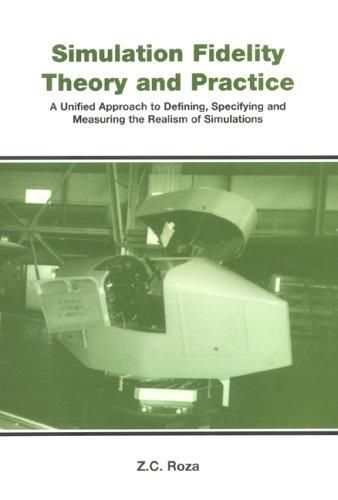
Simulation Fidelity Theory & Practice
0
0
As an Amazon Associate and affiliate partner, Menrva Books earns from qualifying purchases. Learn more
Author Description
This is a Ph.D. dissertation. Simulation fidelity is an intrinsic element of any simulation system, one that all its developers and users have to deal with one way or the other. It is commonly recognized by the modeling and simulation community that simulation fidelity is an essential vehicle in properly assessing the validity and credibility of simulation results. Furthermore, fidelity is one of the main cost-drives of any model or simulation development. Today simulation systems play an increasingly important role in our society, which are rapidly becoming the primary tool for crucial decision-making processes during engineering design, test and evaluation of new systems, even safety-critical systems, and in training of people operating these systems. With this increasing reliance on simulation results it is more than ever important to know how well a simulation corresponds to reality in order to ascertain that the risks involved in using the simulation results are within acceptable limits. Despite these observations and the enormous advancements in simulation hardware and software, the ability to characterize, qualify and quantify the level of simulation fidelity is still a largely uncultivated area. An area in which there exist many incomplete, inconsistent and widely scattered views, concepts and approaches to fidelity. What is primarily lacking is the absence of a systematic and general applicable simulation fidelity assessment methodology, which is based on a sound unifying theory for fidelity and associated practices. This thesis tries to fill this void by the analysis, extension and integration of existing simulation fidelity approaches into a single unified fidelity theory and practice. All this is done from a general simulation system life cycle perspective, not limited by any specific application or problem domain aspects.
Menrva's Summary
THE THESIS
This dissertation addresses the critical need for a systematic and generalizable methodology to assess simulation fidelity. The author, Zwerus Cornelis Roza, tackles the challenge of characterizing, qualifying, and quantifying simulation fidelity, an element intrinsic to all simulation systems that impacts the validity and credibility of results, as well as development costs. Despite the increasing reliance on simulations for crucial decision-making in engineering, testing, and training, a unified theory and practice for fidelity assessment remains underdeveloped, characterized by scattered and inconsistent views. This thesis aims to bridge this gap by analyzing, extending, and integrating existing approaches into a cohesive framework applicable across the entire simulation system life cycle.
THE SCOPE MAP
- A comprehensive analysis of the concept of simulation fidelity and its importance in various decision-making processes.
- Examination of existing, often incomplete and inconsistent, views and approaches to simulation fidelity.
- Development of a unified theory for simulation fidelity, integrating disparate concepts.
- Practical methodologies and practices for assessing simulation fidelity across the system life cycle.
- A generalizable framework applicable beyond specific problem domains or application areas.
THE AUTHORITY PERSPECTIVE
This work is presented as a Ph.D. dissertation, indicating a rigorous academic approach to the subject of simulation fidelity. The author's stated goal is to provide a systematic and generalizable methodology, suggesting a contribution to the field of simulation science and engineering. The thesis aims to unify existing, fragmented approaches into a coherent theory and practice, which would be of interest to researchers and developers in modeling and simulation.
Page Count:
311
Publication Date:
2004-01-01
ISBN-10:
9040725691
ISBN-13:
9789040725692
Science
Non-Fiction
Simulation
Research
Engineering
Methodology
Community Tags
Similar Books