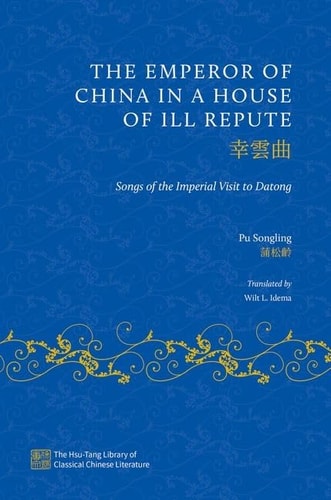
The Emperor of China in a House of Ill Repute: Songs of the Imperial Visit to Datong
0
0
As an Amazon Associate and affiliate partner, Menrva Books earns from qualifying purchases. Learn more
Author Description
The Hsu-Tang Library presents authoritative and eminently readable translations of classical Chinese literature, in bilingual editions, ranging across three millennia and the entire Sinitic world.The Emperor of China in a House of Ill Repute by one of China's most famous authors builds on earlier dramatic works that had been inspired by the antics and travels of the Zhengde emperor (posthumous title Wuzong; r. 1506-1521) of the Ming dynasty. The Zhengde emperor was, despite his reign title ("Right Virtue"), a dismal failure as emperor. His life was given over to the pursuit of pleasure. When in Beijing he often left the palace in disguise and roamed the city incognito. He also made several long and elaborate trips to other parts of the empire, for instance one to Nanjing and Yangzhou, and one to the cities of Datong and Taiyuan in Shanxi. While these historical trips might have had a certain military purpose, the popular imagination saw them as informed by a search for beautiful women. In alternating prose and song, The Emperor of China in a House of Ill Repute tells the tale of the emperor setting out for Datong in the disguise of a common soldier after his evil genius Jiang Bin has told him about the beauty of the three thousand courtesans in the red-light district of this garrison town.This volume presents a fully annotated translation of all twenty-eight chapters of the work, preceded by an Introduction that provides context to the life and works of Pu Songling, the genre of "rustic songs" to which the work belongs, and the specific characteristics of the translated text.
Menrva's Summary
THE PULSE
The Zhengde emperor abandons his imperial duties to embark on a clandestine excursion to Datong, driven by the promise of encountering legendary courtesans. Seeking to escape the rigid confines of the palace, the emperor adopts the disguise of a common soldier, guided by his manipulative advisor Jiang Bin. The narrative follows his pursuit of hedonistic pleasure, contrasting the high status of the throne with the gritty reality of the garrison town's red-light district. The story utilizes a hybrid structure of alternating prose and song to document the emperor's descent into vice and the subsequent consequences of his neglect of state affairs.
INSIDE THE PAGES
- Alternating narrative structure between prose and traditional song
- Satirical depiction of the Ming dynasty imperial court
- Exploration of the tension between duty and personal desire
- Use of disguise as a primary plot device for social mobility
- Detailed annotation of historical and cultural references
- Focus on the genre of rustic songs within classical Chinese literature
- Characterization of the Zhengde emperor as a flawed, pleasure-seeking figure
- Examination of the influence of advisors on imperial decision-making
THE COLLECTIVE ECHO
Readers and critics often highlight the work's unique blend of historical critique and popular entertainment. Discussion frequently centers on the effectiveness of the alternating prose and song format in capturing the atmosphere of the Ming period. Scholars appreciate the inclusion of extensive annotations that provide necessary context for the specific cultural references found within the text. The narrative is noted for its ability to balance the emperor's personal antics with broader commentary on the political failures of the era. Many readers find the translation accessible while maintaining the stylistic nuances of the original classical Chinese source material.
Page Count:
424
Publication Date:
2023-01-01
Publisher:
Oxford University Press
ISBN-10:
019760630X
ISBN-13:
9780197606308
Historical Fiction
Drama
Satire
Chinese
Criticism history
Classical
China
Community Tags
Similar Books