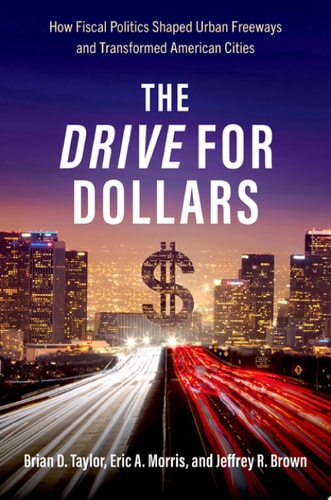
The Drive for Dollars: How Fiscal Politics Shaped Urban Freeways and Transformed American Cities
0
0
As an Amazon Associate and affiliate partner, Menrva Books earns from qualifying purchases. Learn more
Author Description
The story of the interplay between finance, freeways, and urban form in the 20th century and their enduring impact on American cities and neighborhoods in the 21st.American cities are distinct from almost all others in the degree to which freeways and freeway travel dominate urban landscapes. In The Drive for Dollars, Brian D. Taylor, Eric A. Morris, and Jeffrey R. Brown tell the largely misunderstood story of how freeways became the centerpiece of U.S. urban transportation systems, and the crucial, though usually overlooked, role of fiscal politics in bringing freeways about. The authors chronicle how the ways that we both raise and spend transportation revenue have shaped our transportation system and the lives of those who use it, from the era before the automobile to the present day. They focus on how the development of one revolutionary type of road--the freeway--was inextricably intertwined with money. With the nation's transportation finance system at a crossroads today, this book sheds light on how we can best fund and plan transportation in the future. The authors draw on these lessons to offer ways forward to pay for transportation more equitably, provide travelers with better mobility, and increase environmental sustainability and urban livability.
Menrva's Summary
THE THESIS
This book investigates how fiscal policy and revenue-raising mechanisms directly dictated the expansion of urban freeway systems and the subsequent transformation of American city landscapes. The authors, Brian D. Taylor, Eric A. Morris, and Jeffrey R. Brown, utilize historical analysis and economic data to argue that the physical form of modern cities is a direct consequence of specific funding choices made throughout the 20th century. By examining the evolution of transportation finance from the pre-automobile era to the present, the authors provide a framework for understanding why freeways became the dominant mode of urban transit and how these financial structures continue to influence contemporary urban development.
THE SCOPE MAP
What You Will Find
- Historical analysis of 20th-century transportation finance and revenue allocation.
- Examination of the link between fiscal policy and the physical design of urban environments.
- Case studies detailing the political and economic pressures that prioritized freeway construction.
- Policy recommendations for future transportation funding focused on equity, mobility, and environmental sustainability.
THE AUTHORITY PERSPECTIVE
Experts in urban planning and public policy identify this work as a comprehensive analysis of the intersection between fiscal politics and infrastructure development. Readers frequently note the clarity with which the authors connect complex financial mechanisms to tangible outcomes in American urban life.
Page Count:
380
Publication Date:
2023-02-28
Publisher:
Oxford University Press
ISBN-10:
0197601510
ISBN-13:
9780197601518
Economics
History
urban planning
Communication And Traffic
Transportation
Public Policy
Sociology
Community Tags
Similar Books