After the Projects: Public Housing Redevelopment and the Governance of the Poorest Americans
0
0
As an Amazon Associate and affiliate partner, Menrva Books earns from qualifying purchases. Learn more
Author Description
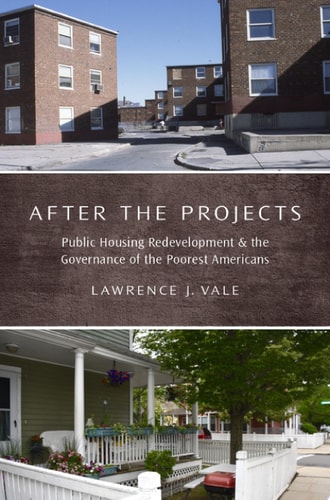
America is in the midst of a rental housing affordability crisis. More than a quarter of those that rent their homes spend more than half of their income for housing, even as city leaders across the United States have been busily dismantling the nation's urban public housing projects. In After the Projects, Lawrence Vale investigates the deeply-rooted spatial politics of public housing development and redevelopment at a time when lower-income Americans face a desperate struggle to find affordable rental housing in many cities. Drawing on more than 200 interviews with public housing residents, real estate developers, and community leaders, Vale analyzes the different ways in which four major American cities implemented the federal government's HOPE VI program for public housing transformation, while also providing a national picture of this program. Some cities attempted to minimize the presence of the poorest residents in their new mixed-income communities, but other cities tried to serve as many low-income households as possible. Through examining the social, political, and economic forces that underlie housing displacement, Vale develops the novel concept of governance constellations. He shows how the stars align differently in each city, depending on community pressures that have evolved in response to each city's past struggles with urban renewal. This allows disparate key players to gain prominence when implementing HOPE VI redevelopment. A much-needed comparative approach to the existing research on public housing, After the Projects shines a light on the broad variety of attitudes towards public housing redevelopment in American cities and identifies ways to achieve more equitable processes and outcomes for low-income Americans.
Menrva's Summary
THE THESIS
How do the governance structures of American cities influence the outcomes of public housing redevelopment and the displacement of low-income residents? Lawrence J. Vale, a professor of urban design and planning at MIT, utilizes his extensive academic background to investigate the implementation of the federal HOPE VI program. He argues that local governance constellations—the unique alignment of political, economic, and social actors—determine whether redevelopment projects prioritize the needs of the poorest residents or favor market-driven displacement.
THE SCOPE MAP
What You Will Find
- Comparative analysis of public housing redevelopment across four major American cities.
- The conceptual framework of governance constellations to explain local policy variations.
- Longitudinal assessment of the federal HOPE VI program's impact on urban landscapes.
Scope Limits
- The study focuses primarily on the implementation of HOPE VI and does not provide an exhaustive history of all federal housing policies since the mid-20th century.
THE AUTHORITY PERSPECTIVE
Experts recognize this work as a significant contribution to urban studies for its rigorous comparative methodology and its focus on the human impact of policy shifts. Readers frequently note the academic density of the prose, which serves as a foundational text for those studying the intersection of urban planning and social equity.
Page Count:
499
Publication Date:
2018-01-01
Publisher:
Oxford University Press
ISBN-10:
0190624353
ISBN-13:
9780190624354
History
Sociology
urban planning
Modern History
Public Housing
Urban renewal
American History
Local government
Earth Sciences
Public Policy
Discrimination
Community Tags
Similar Books