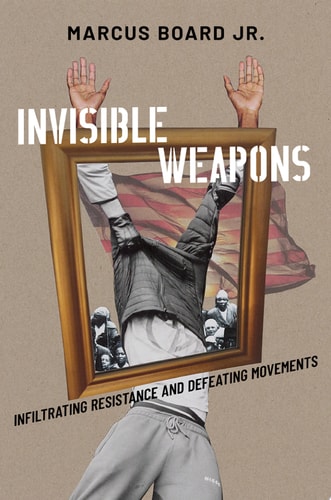
Invisible Weapons: Infiltrating Resistance and Defeating Movements
0
0
As an Amazon Associate and affiliate partner, Menrva Books earns from qualifying purchases. Learn more
Author Description
By the second term of President Obama, Black communities were fully protesting and resisting racist violence from police through the Movement for Black Lives (M4BL). But M4BL organizers cared about more than police violence, and continued in efforts like #SayHerName campaigns to expand the political concerns of followers. In response, elected elites and their supporters engaged in their typical movement-ending tactics - but in addition to the explicit violence of police and capitalism, now they also use invisible weapons.Invisible Weapons uncovers exploitative politics that operate in spite of the largest social movement in history, the M4BL. Agenda-setting elites push against structural change and accountability, convincing grassroots masses that oppression is inevitable and radical resistance is misguided. This is contemporary cooptation - convincing even those who actively participate in the M4BL that change is not a real possibility. This systemic hopelessness is not only the demise of U.S. democracy, but more fundamentally the destruction of grassroots radical resistance. Without this foundational center of grassroots community, all social movements are bound to falter. And without a politically empowered community, so too is the country.Following the story of political cooptation and its destructive impact on Black, Latino/a, Asian, and white communities, Invisible Weapons reveals how everyday people get coerced into neglecting their own power.
Menrva's Summary
THE THESIS
How do political elites and institutional structures effectively neutralize grassroots social movements through the deployment of invisible, psychological, and systemic tactics? Marcus Board, a political scientist, examines the contemporary cooptation of the Movement for Black Lives (M4BL) to illustrate how power structures maintain control. By analyzing the intersection of elite agenda-setting and the erosion of grassroots radicalism, the author argues that systemic hopelessness is a deliberate tool used to convince activists that structural change is impossible. The work provides a framework for understanding how coercion operates within modern democratic systems to suppress collective political power.
THE SCOPE MAP
What You Will Find
- Analysis of the Movement for Black Lives (M4BL) as a primary case study for modern political resistance.
- Examination of cooptation tactics used by elected elites to undermine grassroots organizing.
- Investigation into the psychological mechanisms that foster systemic hopelessness among activists.
- Comparative look at the impact of political manipulation across Black, Latino/a, Asian, and white communities.
THE AUTHORITY PERSPECTIVE
Scholars and political analysts identify this work as a critical contribution to the study of modern social movements and institutional resistance. Readers frequently note the clarity with which the author dissects the subtle, often overlooked methods used to dismantle radical political efforts.
Page Count:
266
Publication Date:
2022-05-31
Publisher:
Oxford University Press
ISBN-10:
0197605222
ISBN-13:
9780197605226
Sociology
Radicalism
Democracy
Neoliberalism
Activism
Community Tags
Similar Books