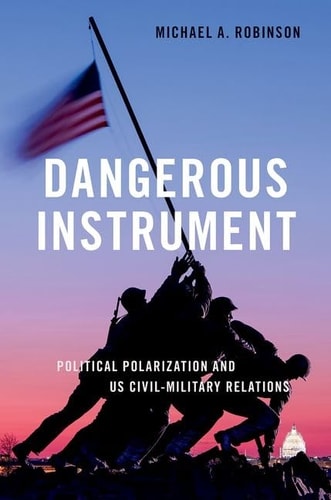
Dangerous Instrument: Political Polarization and US Civil-Military Relations
0
0
As an Amazon Associate and affiliate partner, Menrva Books earns from qualifying purchases. Learn more
Author Description
As increasingly contentious politics in the United States raise concerns over the "politicization" of traditionally non-partisan institutions, many have turned their attention to how the American military has been--and will be--affected by this trend. Since a low point following the end of the Vietnam War, the U.S. military has experienced a dramatic reversal of public opinion, becoming one of the most trusted institutions in American society. However, this trend is more complicated than it appears: just as individuals have become fonder of their military, they have also become increasingly polarized from one another along partisan lines. The result is a new political environment rife with challenges to traditional civil-military norms.In a data-driven analysis of contemporary American attitudes, Dangerous Instrument examines the current state of U.S. civil-military affairs, probing how the public views their military and the effect that partisan tribalism may have on that relationship in the future. Michael A. Robinson studies the sources and potential limits of American trust in the armed services, focusing on the interplay of the public, political parties, media outlets, and the military itself on the prospect of politicization and its associated challenges. As democratic institutions face persistent pressure worldwide, Dangerous Instrument provides important insights into the contemporary arc of American civil-military affairs and delivers recommendations on ways to preserve a non-partisan military.
Menrva's Summary
THE THESIS
This book investigates how increasing political polarization in the United States threatens the traditional non-partisan status of the American military. Michael A. Robinson, a scholar in civil-military relations, utilizes a data-driven approach to analyze public opinion and institutional trust. He argues that while the military remains a highly trusted institution, the rise of partisan tribalism creates significant risks for the long-term stability of civil-military norms. The work provides a framework for understanding how political parties and media influence the public's perception of the armed services.
THE SCOPE MAP
What You Will Find
- Quantitative analysis of contemporary American public attitudes toward the armed forces.
- Examination of the historical shift in military prestige since the Vietnam War.
- Assessment of the influence exerted by political parties and media outlets on military politicization.
- Strategic recommendations for maintaining institutional neutrality in a polarized environment.
THE AUTHORITY PERSPECTIVE
Experts identify this work as a significant contribution to the study of modern civil-military relations, particularly for its focus on the intersection of public opinion and institutional integrity. Readers frequently note the clarity of the data analysis and the practical relevance of the author's policy recommendations for democratic governance.
Page Count:
312
Publication Date:
2022-12-08
Publisher:
Oxford University Press
ISBN-10:
0197611567
ISBN-13:
9780197611562
Sociology
Government
United States
Public Policy
Military History
Local government
Community Tags
Similar Books