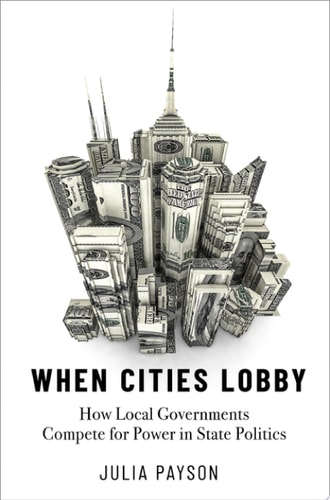
When Cities Lobby: How Local Governments Compete for Power in State Politics
0
0
As an Amazon Associate and affiliate partner, Menrva Books earns from qualifying purchases. Learn more
Author Description
In a political environment characterized by intense urban-rural polarization and growing hostility between cities and state legislatures, When Cities Lobby explores how local officials use lobbyists to compete for power in state politics.When Cities Lobby tells the story of what happens when city officials rely on professional lobbyists to represent their interests in state government. In a political environment characterized by intense urban-rural polarization and growing hostility between cities and state legislatures, the ability to lobby offers a powerful tool for city leaders seeking to amplify their voices in state politics. The cities that lobby at the highest rates include large urban centers that have historically faced obstacles to effective representation in our federal system, and, increasingly, blue-leaning cities engaged in preemption battles against Republican-led legislatures. But high-income places have also figured out how to strategically use lobbyists, and these communities have become particularly adept at lobbying to secure additional grant money and shift state funding in a direction that favors them. How did we end up with a system where political officials in different levels of government often choose to pay lobbyists to facilitate communication between them, and are the potential benefits worth the costs? Author Julia Payson demonstrates that the answer is deeply rooted in both the nature of the federal system and the evolution of the professional lobbying industry. While some states have recently debated measures to restrict lobbying by local governments, these efforts will likely do more harm than good in the absence of structural reforms to the lobbying industry more broadly.
Menrva's Summary
THE THESIS
This book investigates the strategic role of professional lobbyists in mediating the increasingly contentious relationship between local municipal governments and state legislatures. Julia Payson, a political scientist, utilizes a combination of original data collection and historical analysis to examine how cities navigate urban-rural polarization. She argues that lobbying has become a critical, albeit complex, mechanism for local officials to secure resources and influence policy within the constraints of the American federal system.
THE SCOPE MAP
What You Will Find
- Analysis of the professional lobbying industry's evolution within state-level politics.
- Examination of the tension between blue-leaning urban centers and Republican-led state legislatures.
- Comparative study of how high-income versus large urban municipalities utilize lobbying for grant acquisition.
- Evaluation of proposed legislative restrictions on local government lobbying and their potential systemic impacts.
THE AUTHORITY PERSPECTIVE
Experts in political science and urban governance identify this work as a significant contribution to the study of intergovernmental relations. Readers frequently note the clarity with which the author connects historical federal structures to modern-day lobbying practices.
Page Count:
200
Publication Date:
2021-01-01
Publisher:
Oxford University Press
ISBN-10:
0197615295
ISBN-13:
9780197615294
Sociology
Comparative Politics
Rural
Public Policy
Government
United States
Urban Studies
Community Tags
Similar Books