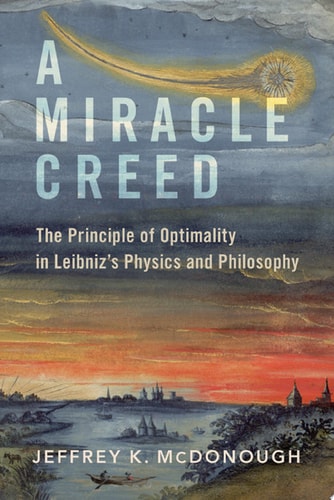
A Miracle Creed: The Principle of Optimality in Leibniz's Physics and Philosophy
0
0
As an Amazon Associate and affiliate partner, Menrva Books earns from qualifying purchases. Learn more
Author Description
A rival to Isaac Newton in mathematics and physics, Gottfried Wilhelm Leibniz believed that our world--the best of all possible worlds--must be governed by a principle of optimality. This book explores Leibniz's pursuit of optimality in five of his most important works in natural philosophy and shows how his principle of optimality bridges his scientific and philosophical studies. The first chapter explores Leibniz's work on the laws of optics and its implications for his defense of natural teleology. The second chapter examines Leibniz's work on the breaking strength of rigid beams and its implications for his thinking about the metaphysical foundations of the material world. The third chapter revisits Leibniz's famous defense of the conservation of vis viva and proposes a novel account of the origin of Leibniz's mature natural philosophy. The fourth chapter takes up Leibniz's efforts to determine the shape of freely hanging chains--the so-called problem of the catenary--and shows how that work provides an illuminating model for his thinking about the teleological structure of wills. Finally, the fifth chapter uses Leibniz's derivation of the path of quickest descent--his solution to the so-called problem of the Brachistochrone--and its historical context as a springboard for an exploration of the legacy of Leibniz's physics. The book closes with a brief discussion of the systematicity of Leibniz's thinking in philosophy and the natural sciences.
Menrva's Summary
THE THESIS
This book investigates the central role of the principle of optimality in the natural philosophy and metaphysical framework of Gottfried Wilhelm Leibniz. Jeffrey K. McDonough, a scholar specializing in early modern philosophy, utilizes a rigorous analysis of five key texts to demonstrate how Leibniz integrated mathematical physics with teleological reasoning. By examining specific scientific problems, the author argues that Leibniz's commitment to optimality serves as the essential bridge between his physical laws and his broader philosophical worldview.
THE SCOPE MAP
What You Will Find
- Analysis of Leibniz's work on optics and the defense of natural teleology.
- Examination of the breaking strength of rigid beams and its metaphysical implications.
- Investigation into the conservation of vis viva and the origins of mature natural philosophy.
- Exploration of the catenary problem and the Brachistochrone as models for teleological structure.
- A synthesis of the systematic nature of Leibniz's scientific and philosophical thought.
THE AUTHORITY PERSPECTIVE
Scholars and historians of philosophy recognize this work as a significant contribution to understanding the intersection of Leibnizian physics and metaphysics. Readers frequently note the academic density of the prose, which is tailored for those with a background in early modern philosophy or the history of science.
Page Count:
250
Publication Date:
2022-02-02
Publisher:
Oxford University Press
ISBN-10:
0197629075
ISBN-13:
9780197629079
Philosophy
Academic
Metaphysics
Physics
Teleology
Community Tags
Similar Books