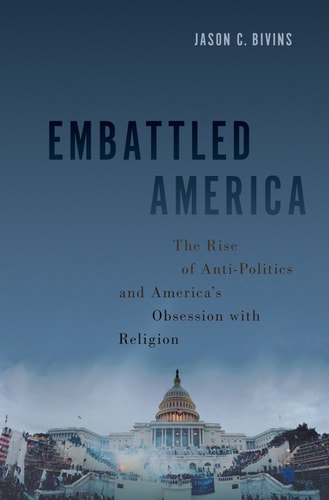
Embattled America: The Rise of Anti-Politics and America's Obsession with Religion
0
0
As an Amazon Associate and affiliate partner, Menrva Books earns from qualifying purchases. Learn more
Author Description
Histories of political religion since the 1960s often center on the rise of the powerful conservative evangelical voting bloc since the 1970s. One of the beliefs that has united these citizens is the idea that they are treated unfairly or are marginalized, despite their significant influence on public life. From the ascent of Reagan to the "Contract with America," from 9/11 to Obama to Trump--these claims have moved steadily to the center of conservative activism.Scholars of religion have approached these phenomena with great caution, generally focusing on institutional history, or relying on journalistic conveniences like "populism," or embracing the self-understandings of evangelicals themselves. None of these approaches is sufficiently calibrated to decoding the fierce convergence of online conspiracy theory, public violence, white supremacy, and religious authoritarianism. Accepting the narrative of Embattlement on its own terms, or examining it as mere turbulence on the path of American pluralism, overlooks how such deeper structural or atmospheric conditions work through this discourse to undermine the actual practice of democratic politics.Exploring the impact of these claims through case studies ranging from the Tea Party to Birthers to anti-sharia laws, Embattled America digs deeper into the debates between Martyrs (those who profess persecution) and Whistleblowers (those who sanctimoniously refute such claims). Hidden beneath each of these episodes is a series of ambivalences about democracy that require attention. Jason Bivins argues that the claims of Martyrs and Whistleblowers are symptoms of America's larger failings to strengthen the conditions for democratic life, and thus that rather than engaging their claims on the merits, concerned citizens should reassess fundamental democratic norms as part of a broader challenge to embolden American citizenship and institutions.
Menrva's Summary
THE THESIS
This book investigates how the rhetoric of religious persecution and embattlement functions as a mechanism to undermine democratic norms and institutions in contemporary American politics. Jason C. Bivins, a scholar of religion, critiques existing academic and journalistic frameworks that fail to account for the convergence of conspiracy theories, white supremacy, and authoritarianism. He argues that the binary conflict between those claiming martyrdom and those acting as whistleblowers serves as a distraction from deeper systemic failures in American civic life. Bivins proposes that citizens must move beyond debating these specific claims and instead focus on strengthening the fundamental conditions required for a healthy democracy.
THE SCOPE MAP
What You Will Find
- Analysis of political movements including the Tea Party, the Birther movement, and anti-sharia legislation.
- A critical examination of the intersection between online conspiracy theories and religious authoritarianism.
- A theoretical framework distinguishing between the rhetoric of 'Martyrs' and 'Whistleblowers' in public discourse.
- An assessment of how claims of marginalization are utilized by groups with significant influence on public policy.
THE AUTHORITY PERSPECTIVE
Experts recognize this work as a rigorous intervention in the study of American political religion, noting its departure from standard institutional histories. Readers frequently highlight the analytical density of the prose, which demands careful engagement with the author's critique of democratic discourse.
Page Count:
348
Publication Date:
2022-01-01
Publisher:
Oxford University Press
ISBN-10:
0197623522
ISBN-13:
9780197623527
Religion
History
Politics
Sociology
Church History
American Studies
Community Tags
Similar Books