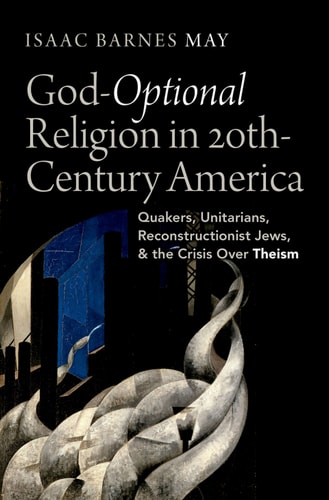
God-Optional Religion in Twentieth-Century America: Quakers, Unitarians, Reconstructionist Jews, and the Crisis Over Theism
0
0
As an Amazon Associate and affiliate partner, Menrva Books earns from qualifying purchases. Learn more
Author Description
By the beginning of the twentieth century, it had become harder for many Americans to believe in God. Religious groups struggled to adapt to rapidly changing cultural and scientific developments that seemed to challenge the plausibility of traditional beliefs. In God-Optional Religion in Twentieth-Century America, Isaac Barnes May focuses on the stories of three groups-liberal Quakers, Unitarians, and the forerunners of what would become Reconstructionist Judaism-that attempted to preserve their faith in the modern world by redefining what it meant to be religious. Between the 1920s and the 1960s, these communities underwent the most massive theological change imaginable, allowing their members the choice of what kind of God they wanted to believe in, or the option to not believe in God at all.These groups pioneered the idea that being religious and believing in God might be separate concepts, a notion that spread widely, moving from church pulpits to novels and magazine covers. Eventually, the Supreme Court enshrined the idea that "God" could mean many different things in American law. God-Optional Religion in Twentieth-Century America provides an intellectual history that helps make sense of why most contemporary Americans' answer to whether they believe in God is often far more complicated than a simple "yes" or "no."
Menrva's Summary
THE THESIS
This book investigates how specific American religious groups navigated the decline of traditional theism by decoupling religious identity from the necessity of belief in a deity. Isaac Barnes May, a scholar of American religious history, utilizes archival research and theological records to trace the evolution of liberal Quakerism, Unitarianism, and early Reconstructionist Judaism. He argues that these groups facilitated a transition toward a 'God-optional' framework, which fundamentally altered the American religious landscape between the 1920s and the 1960s.
THE SCOPE MAP
What You Will Find
- Historical analysis of theological shifts within liberal Quaker, Unitarian, and Reconstructionist Jewish communities.
- Examination of the cultural and scientific pressures that challenged traditional theism in the twentieth century.
- Documentation of the legal and social evolution of the definition of 'God' in American public life.
- Exploration of the transition from dogmatic belief to individualistic religious expression.
THE AUTHORITY PERSPECTIVE
Experts recognize this work as a significant contribution to the intellectual history of American secularization and religious adaptation. Readers frequently note the clarity with which the author navigates complex theological transitions while maintaining a focus on the broader societal implications of these shifts.
Page Count:
340
Publication Date:
2022-01-01
Publisher:
Oxford University Press
ISBN-10:
0197624251
ISBN-13:
9780197624258
Religion
History
American History
Sociology of Religion
Bahai Faith
Theology
World Religions
Community Tags
Similar Books