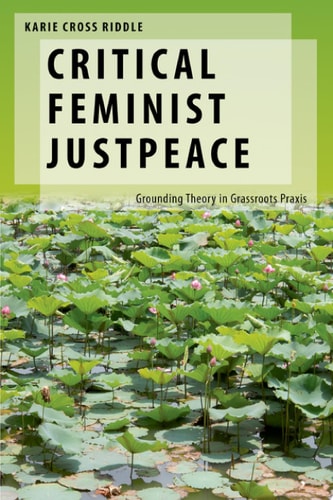
Critical Feminist Justpeace: Grounding Theory in Grassroots Praxis
0
0
As an Amazon Associate and affiliate partner, Menrva Books earns from qualifying purchases. Learn more
Author Description
In 2020, feminist scholars and activists celebrated the twentieth anniversary of the United Nations' Women, Peace and Security (WPS) agenda, a landmark achievement that mainstreams gendered concerns into international peace and security. Yet despite its successes, no international agenda can comprehensively address all sources of violence that women face, and the WPS community remains divided on important issues regarding implementation and substance.In Critical Feminist Justpeace, Karie Cross Riddle presents an intersectional revision to conflict transformation, arguing that we need complementary theories and practices of gender-conscious peacebuilding for regions and conflicts that the WPS agenda cannot reach. Riddle draws on fieldwork and conversations with women peacebuilders in Manipur, India, where an intractable, low-intensity armed conflict has troubled the region for over six decades. India refuses to legally acknowledge the conflict, and thus bars international and humanitarian actors from entry. This renders the conflict ineligible for WPS intervention. The case of Manipur poses an important question: under what conditions should transnational feminists employ the WPS agenda--benefitting from its formal, international legitimacy--and under what conditions should they seek alternative paths to peace?Critical Feminist Justpeace makes the case that we need norms and processes for feminist peacebuilding that can flexibly respond to the particularities of national and local politics and social context. To advocate for contextually-sensitive peacebuilding driven by local actors, Riddle introduces a novel theory--critical feminist justpeace--that provides an intersectional orientation towards conflict transformation. Its aim is to reduce structural power hierarchies and violence, increase equitable justice outcomes across public and private life, and target historically marginalized participants. Original and insightful, Riddle's theoretical framework serves as
Menrva's Summary
THE THESIS
How can transnational feminist movements effectively address violence in regions where international frameworks like the UN's Women, Peace and Security (WPS) agenda are structurally unable to intervene? Karie Cross Riddle, a scholar of international relations, utilizes her extensive fieldwork in Manipur, India, to evaluate the limitations of top-down peacebuilding initiatives. She proposes a new theoretical framework, 'critical feminist justpeace,' which prioritizes intersectional, grassroots-led strategies to dismantle structural power hierarchies and address violence in contexts ignored by formal international policy.
THE SCOPE MAP
What You Will Find
- An analysis of the twentieth-anniversary implementation of the UN Women, Peace and Security (WPS) agenda.
- A detailed case study of the six-decade-long, low-intensity armed conflict in Manipur, India.
- A proposed theoretical framework for 'critical feminist justpeace' that emphasizes local, context-sensitive peacebuilding.
- Methodological insights derived from qualitative fieldwork and interviews with local women peacebuilders.
THE AUTHORITY PERSPECTIVE
Experts in international relations and gender studies recognize this work as a significant contribution to the critique of institutionalized peacebuilding. Readers frequently note the academic density of the prose, which serves as a rigorous examination of the intersection between local activism and global policy frameworks.
Page Count:
272
Publication Date:
2024-10-25
Publisher:
Oxford University Press
ISBN-10:
0197786588
ISBN-13:
9780197786581
Politics
Peace studies
International relations
Feminist Theory
Specific Topics
Gender Studies
Sociology
Community Tags
Similar Books