The Fasces: A History of Ancient Rome's Most Dangerous Political Symbol
0
0
As an Amazon Associate and affiliate partner, Menrva Books earns from qualifying purchases. Learn more
Author Description
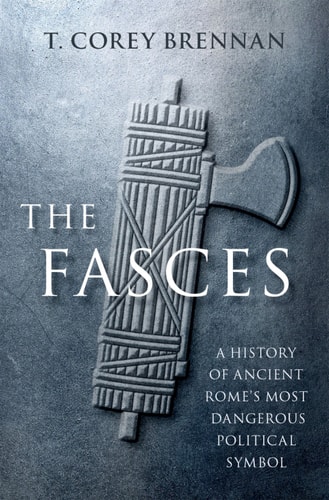
"Fascism" is a word ubiquitous in our contemporary political discourse, but few know about its roots in the ancient past or its long, strange evolution to the present.In ancient Rome, the fasces were a bundle of wooden rods bound with a leather cord, in which an axe was placed--in essence, a mobile kit for corporal or capital punishment. Attendants typically carried fasces before Rome's higher officials, to induce feelings of respect and fear for the relevant authority. This highly performative Roman institution had a lifespan of almost two millennia, and made a deep impression on subsequent eras, from the Byzantine period to the present.Starting in the Renaissance, we find revivals and reinterpretations of the ancient fasces, accelerating especially after 1789, the first year of the United States' Constitution and the opening volley of the French Revolution. But it was Benito Mussolini, who, beginning in 1919, propagated the fasces on an unprecedented scale. Oddly, today the emblem has grown largely unfamiliar, which in turn has offered an opening to contemporary extremist groups.In The Fasces, T. Corey Brennan offers the first global history of the nature, development, and competing meanings of this stark symbol, from antiquity to the twenty-first century. The word "fascism" has universal awareness in contemporary political discourse, which thus makes this, the first book to trace the full arc of the fasces' almost 3,000-year history, essential reading for all who wish to understand how the past informs the present.
Menrva's Summary
THE THESIS
This book investigates the historical origins, evolution, and shifting political significance of the Roman fasces from antiquity to the modern era. T. Corey Brennan, a scholar of Roman history, utilizes a vast array of historical evidence to trace how a simple bundle of rods and an axe transformed from a symbol of Roman magisterial authority into a potent, often misunderstood, emblem of modern political movements. The work argues that the symbol's long lifespan and adaptability have allowed it to be co-opted by diverse ideologies, necessitating a rigorous examination of its past to clarify its contemporary implications.
THE SCOPE MAP
What You Will Find
- A comprehensive timeline spanning nearly 3,000 years of history.
- Analysis of the fasces as a performative tool of Roman state power.
- Examination of the symbol's revival during the Renaissance and the French Revolution.
- Investigation into the appropriation of the emblem by Mussolini and its subsequent decline in public recognition.
THE AUTHORITY PERSPECTIVE
Scholars and historians recognize this work as the first comprehensive global history of the fasces, providing much-needed clarity on a frequently misused political icon. Readers note the academic rigor of the text, which serves as a foundational resource for understanding the intersection of ancient symbolism and modern political discourse.
Page Count:
303
Publication Date:
2022-01-01
Publisher:
Oxford University Press
ISBN-10:
0197644902
ISBN-13:
9780197644904
History
American History
Cultural History
Symbolism
Ancient History
European History
Community Tags
Similar Books