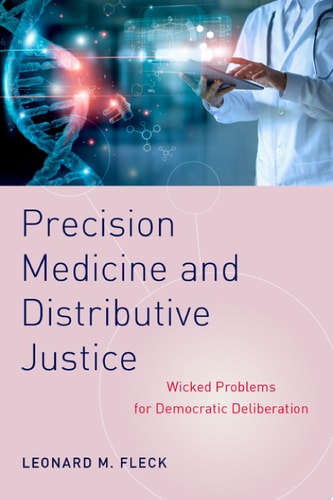
Precision Medicine and Distributive Justice: Wicked Problems for Democratic Deliberation
0
0
As an Amazon Associate and affiliate partner, Menrva Books earns from qualifying purchases. Learn more
Author Description
Metastatic cancer and costly precision medicines generate extremely complex problems of health care justice. Targeted cancer therapies yield only very marginal gains in life expectancy for most patients at very great cost, thereby threatening the just allocation of limited health care resources. Philosophers have high hopes for the utility of their theories of justice in addressing the challenges of resource allocation; however, none of these theories can address adequately the “wicked” ethical problems that have resulted from these targeted therapies.What we need instead, bioethicist Leonard M. Fleck argues, is a political conception of health care justice, following Rawls, and a fair and inclusive process of rational democratic deliberation governed by public reason. His account makes the basic assumption that we have only limited health care resources to meet unlimited health care needs generated by emerging medical technologies. The primary ethical and political virtue of rational democratic deliberation is that it allows citizens to fashion autonomously shared understandings of how to fairly address the complex problems of health care justice generated by precision medicine. While ideally just outcomes are a moral and political impossibility, “wicked” problems can metastasize if rationing decisions are made invisibly--in ways effectively hidden from those affected by those decisions. As Fleck demonstrates, a fair and inclusive process of democratic deliberation could make these “wicked” problems visible, and subject, to public reason.
Menrva's Summary
THE THESIS
How can democratic societies ethically manage the allocation of limited health care resources when confronted with the high costs and marginal benefits of precision medicine? Leonard M. Fleck, a prominent bioethicist, examines the intersection of medical innovation and distributive justice. He argues that traditional philosophical theories are insufficient for addressing the "wicked" problems posed by targeted therapies and proposes a framework centered on rational democratic deliberation and public reason to navigate these complex ethical dilemmas.
THE SCOPE MAP
What You Will Find
- Analysis of the economic and ethical tensions between precision medicine and health care resource allocation.
- A critique of traditional philosophical theories of justice in the context of modern medical technology.
- A proposed model for inclusive, rational democratic deliberation as a tool for public policy.
- Examination of the risks associated with opaque or invisible rationing decisions in clinical settings.
THE AUTHORITY PERSPECTIVE
Experts in bioethics and health policy recognize this work as a significant contribution to the discourse on public reason and medical resource management. Readers frequently note the academic density of the prose, which is tailored for scholars and practitioners engaged in the intersection of political philosophy and clinical ethics.
Page Count:
432
Publication Date:
2022-09-26
Publisher:
Oxford University Press
ISBN-10:
0197647723
ISBN-13:
9780197647721
Philosophy
Kindle Store
Bioethics
Medical Ethics
Categories
Kindle eBooks
Medicine
Community Tags
Similar Books