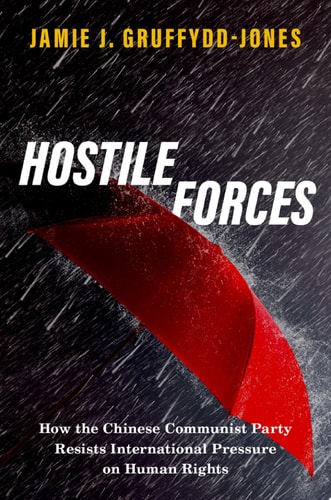
Hostile Forces: How the Chinese Communist Party Resists International Pressure on Human Rights
0
0
As an Amazon Associate and affiliate partner, Menrva Books earns from qualifying purchases. Learn more
Author Description
How do authoritarian regimes deal with pressure from the international community? China's leaders have been subject to decades of international attention, condemnation, resolutions, boycotts, and sanctions over their treatment of human rights. We assume that hearing about all this pressure will make the public more concerned about human rights, and so regimes like the Chinese Communist Party (CCP) should do what they can to prevent this from happening. In Hostile Forces, Jamie Gruffydd-Jones argues that while international pressure may indeed embarrass authoritarian leaders on the international stage, it may, in fact, benefit them at home. The targets of human rights pressure, regimes like the Communist Party, are not merely passive recipients, but actors who can proactively shape and deploy that pressure for their own advantage. Taking us through an exploration of the history of the Communist Party's reactions to foreign pressure, from condemnation of Mao's crackdowns in Tibet to outrage at the outbreak of COVID-19, analysis of a novel database drawn from state media archives, as well as multiple survey experiments and hundreds of interviews, Gruffydd-Jones shows that the CCP uses the most 'hostile' pressure strategically - and successfully - to push citizens to view human rights in terms of international geopolitics rather than domestic injustice, and reduce their support for change. The book shines a light on how regimes have learnt to manage, manipulate, and resist foreign pressure on their human rights, and illustrates how support for authoritarian and nationalist policies might grow in the face of a liberal international system.
Menrva's Summary
THE THESIS
How do authoritarian regimes effectively neutralize international pressure regarding human rights to bolster domestic support? Jamie J. Gruffydd-Jones, a political scientist, examines the strategic responses of the Chinese Communist Party to foreign criticism. By analyzing state media archives, conducting survey experiments, and performing extensive interviews, the author argues that the CCP proactively reframes international condemnation as a geopolitical threat to national sovereignty, thereby suppressing domestic dissent and strengthening nationalist sentiment.
THE SCOPE MAP
What You Will Find
- Analysis of historical CCP reactions to foreign pressure from the Mao era to the COVID-19 pandemic.
- A novel database constructed from state media archives to track rhetorical shifts.
- Methodology involving multiple survey experiments to measure public perception.
- Qualitative evidence derived from hundreds of interviews with relevant stakeholders.
THE AUTHORITY PERSPECTIVE
Experts identify this work as a significant contribution to the study of authoritarian resilience and international political communication. Scholars frequently note the empirical rigor of the author's methodology in mapping how regimes manipulate external pressure for internal political gain.
Page Count:
260
Publication Date:
2022-01-01
Publisher:
Oxford University Press
ISBN-10:
0197643221
ISBN-13:
9780197643228
Civil Rights
Autoritarisme
Communism
China
Communism history
Comparative Politics
Authoritarianism
Communisme
International relations
Human rights
Geopolitics
Community Tags
Similar Books