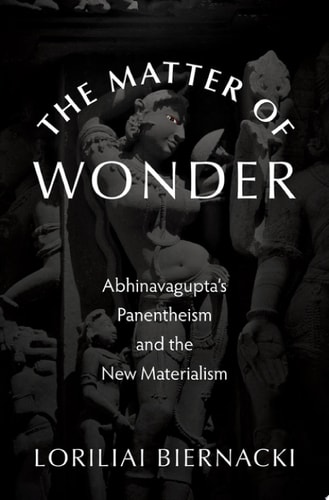
The Matter of Wonder: Abhinavagupta's Panentheism and the New Materialism
0
0
As an Amazon Associate and affiliate partner, Menrva Books earns from qualifying purchases. Learn more
Author Description
In the early 11th century, the Kashmiri philosopher Abhinavagupta proposed panentheism-seeing the divine as both immanent in the world and at the same time as transcendent--as a way to reclaim the material world as something real, something solid. His theology understood the world itself, with its manifold inhabitants--from gods to humans to insects down to the merest rock-as part of the unfolding of a single conscious reality, Siva. This conscious singularity-the word "god" here does not quite do it justice--with its capacity to choose and will, pervades all through, top to bottom; as Abhinavagupta writes, "even down to a worm -- when they do their own deeds, that which is to be done first stirs in the heart." His panentheism proposed an answer to a familiar conundrum, one we still grapple with today: Consciousness is so unlike matter. How does consciousness actually connect to the materiality of our world? To put this in more familar twenty-first-century terms, how does mind connect to body?These questions drive Loriliai Biernacki's The Matter of Wonder: Abhinavagupta's Panentheism and New Materialism. Biernacki draws on Abhinavagupta's thought--and particularly his yet-untranslated, philosophical magnum opus, the Isvara Pratyabhijña Vivrti Vimarsini--to think through contemporary issues such as the looming prospect of machine AI, ideas about information, and our ecological crises. She argues that Abhinavagupta's panentheism can help us understand our current world and can contribute to a New Materialist re-envisioning of the relationship that humans have with matter.
Menrva's Summary
THE THESIS
Can the 11th-century panentheistic philosophy of Abhinavagupta provide a viable framework for addressing contemporary ontological dilemmas regarding the relationship between consciousness and matter? Loriliai Biernacki, a scholar of South Asian religions, utilizes Abhinavagupta's complex theological writings—specifically the Isvara Pratyabhijña Vivrti Vimarsini—to bridge the gap between classical Kashmiri Shaivism and modern discourse. By examining the concept of a singular, conscious reality that permeates all physical forms, the author argues that this ancient perspective offers a robust alternative to current dualistic models of mind and body.
THE SCOPE MAP
What You Will Find
- An analysis of Abhinavagupta's panentheism as a bridge between immanence and transcendence.
- A comparative study between classical Indian philosophy and contemporary New Materialist theory.
- Applications of ancient metaphysical frameworks to modern challenges like artificial intelligence and ecological crisis.
- Interpretations of the Isvara Pratyabhijña Vivrti Vimarsini regarding the nature of information and conscious agency.
THE AUTHORITY PERSPECTIVE
Scholars and students of philosophy frequently note the high level of academic rigor required to engage with Biernacki's synthesis of classical Sanskrit texts and modern materialist theory. Experts highlight this work as a significant contribution to the field of comparative philosophy, particularly for its ability to place non-Western metaphysical traditions into active dialogue with current scientific and technological debates.
Page Count:
264
Publication Date:
2023-02-06
Publisher:
Oxford University Press
ISBN-10:
0197643078
ISBN-13:
9780197643075
Religion
Philosophy
Consciousness Studies
Hinduism
Metaphysics
Community Tags
Similar Books