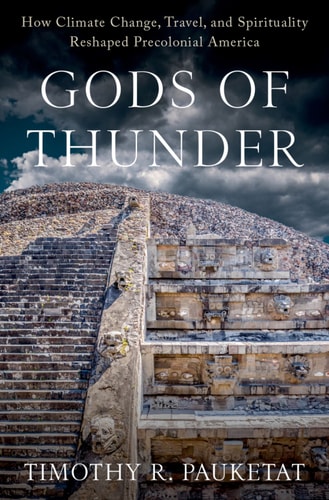
Gods of Thunder: How Climate Change, Travel, and Spirituality Reshaped Precolonial America
0
0
As an Amazon Associate and affiliate partner, Menrva Books earns from qualifying purchases. Learn more
Author Description
A sweeping account of Medieval North America when Indigenous peoples confronted climate change. Few Americans today are aware of one of the most consequential periods in North American history--the Medieval Warm Period of seven to twelve centuries ago (AD 800-1300 CE)--which resulted in the warmest temperatures in the northern hemisphere since the "Roman Warm Period," a half millennium earlier. Reconstructing these climatic events and the cultural transformations they wrought, Timothy Pauketat guides readers down ancient American paths walked by Indigenous people a millennium ago, some trod by Spanish conquistadors just a few centuries later. The book follows the footsteps of priests, pilgrims, traders, and farmers who took great journeys, made remarkable pilgrimages, and migrated long distances to new lands. Along the way, readers will discover a new history of a continent that, like today, was being shaped by climate change--or controlled by ancient gods of wind and water. Through such elemental powers, the history of Medieval America was a physical narrative, a long-term natural and cultural experience in which Native people were entwined long before Christopher Columbus arrived or Hernán Cortés conquered the Aztecs. Spanning most of the North American continent, Gods of Thunder focuses on remarkable parallels between pre-contact American civilizations separated by a thousand miles or more. Key archaeological sites are featured in every chapter, leading us down an evidentiary trail toward the book's conclusion that a great religious movement swept Mesoamerica, the Southwest, and the Mississippi valley, sometimes because of worsening living conditions and sometimes by improved agricultural yields thanks to global warming a thousand years ago. The author also includes a guide to visiting the archaeological sites discussed in the book.
Menrva's Summary
THE THESIS
This work investigates how the Medieval Warm Period (AD 800-1300) acted as a catalyst for profound cultural, religious, and migratory shifts across precolonial North America. Timothy R. Pauketat, a distinguished archaeologist, utilizes extensive site data and historical evidence to argue that Indigenous societies were not static, but were actively responding to environmental fluctuations through the development of new religious movements and long-distance networks. By connecting archaeological findings from Mesoamerica to the Mississippi Valley, the author demonstrates how climate-driven changes in agriculture and living conditions necessitated a continent-wide transformation in social and spiritual organization.
THE SCOPE MAP
What You Will Find
- Analysis of the Medieval Warm Period and its impact on North American agricultural cycles.
- Examination of religious movements and pilgrimage patterns across the Southwest and Mississippi Valley.
- Synthesis of archaeological evidence from major pre-contact sites.
- A practical guide for readers to visit the specific archaeological locations discussed in the text.
THE AUTHORITY PERSPECTIVE
Experts recognize this text as a significant contribution to the study of pre-Columbian history, noting its ability to synthesize complex climate data with cultural anthropology. Readers frequently highlight the accessibility of the prose, which balances rigorous archaeological detail with a clear, engaging narrative structure.
Page Count:
346
Publication Date:
2023-01-01
Publisher:
Oxford University Press
ISBN-10:
0197645127
ISBN-13:
9780197645123
History
History of the Americas
Anthropology
Human ecology
Climate Change
European History
Archaeology
Community Tags
Similar Books