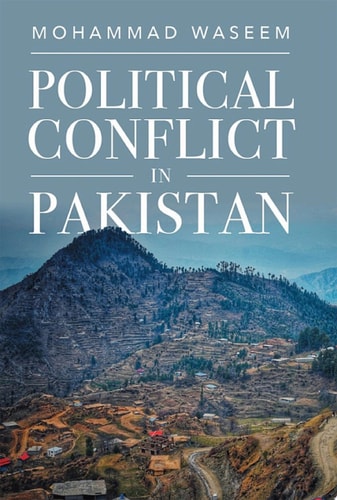
Political Conflict in Pakistan
0
0
As an Amazon Associate and affiliate partner, Menrva Books earns from qualifying purchases. Learn more
Author Description
This book is a major reinterpretation of politics in Pakistan. Its focus is conflict among groups, communities, classes, ideologies and institutions, which has shaped the country's political dynamics. Mohammad Waseem critically examines the theory surrounding the millennium-long conflict between Hindus and Muslims as separate nations who practiced mingled faiths, and the Hindu, Muslim and Sikh renaissances that created a twentieth-century clash of communities and led to partition. Political Conflict in Pakistan addresses multiple clashes: between the high culture as a mission to transform society, and the low culture of the land and the people; between those committed to the establishment's institutional constitutional framework and those seeking to dismantle the "colonial" state; between the corrupt and those seeking to hold them to account; between the political class and the middle class; and between civil and military power. The author exposes how the ruling elite centralised power through the militarisation and judicialization of politics, rendering the federalist arrangement an empty shell and thus grossly alienating the provinces. He sets all this within the contexts of education and media as breeders of conflict, the difficulties of establishing an anti-terrorist regime, and the state's pragmatic attempts at conflict resolution by seeking to keep the outsiders inside. This is a wide-ranging account of a country of contestations.
Menrva's Summary
THE THESIS
This book investigates the structural and ideological roots of political instability in Pakistan by analyzing the persistent conflicts between competing social, institutional, and cultural forces. Mohammad Waseem, a prominent scholar of Pakistani politics, utilizes a historical and institutional framework to examine how the state's evolution has been defined by deep-seated tensions. He argues that the centralization of power by the ruling elite, through the militarization and judicialization of governance, has systematically undermined federalism and alienated various segments of the population. By tracing these conflicts from the pre-partition era to the modern day, the author provides a comprehensive critique of the state's failure to resolve internal contestations.
THE SCOPE MAP
What You Will Find
- Historical analysis of the communal clashes between Hindu, Muslim, and Sikh populations leading to the 1947 partition.
- Examination of the institutional power struggle between civil and military authorities.
- Evaluation of the role of education and media in perpetuating societal divisions.
- Assessment of the state's pragmatic, often failed, attempts at conflict resolution and anti-terrorist policy.
THE AUTHORITY PERSPECTIVE
Scholars and political analysts recognize this work as a rigorous and essential text for understanding the complex power dynamics within Pakistan. Readers frequently note the academic density of the prose, which provides a thorough, evidence-based account of the country's institutional challenges.
Page Count:
766
Publication Date:
2022-01-01
Publisher:
Oxford University Press
ISBN-10:
0197654266
ISBN-13:
9780197654262
History
Sociology
Government - Asia
Asian
Pakistan
International relations
Community Tags
Other Editions(4)


Similar Books


Reader Comments
Share Your Thoughts
No comments yet. Be the first to share your thoughts!