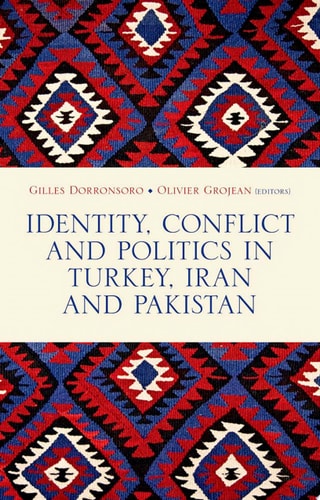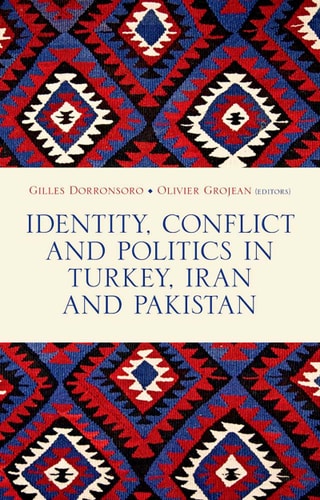
Identity, Conflict and Politics in Turkey, Iran and Pakistan
0
0
As an Amazon Associate and affiliate partner, Menrva Books earns from qualifying purchases. Learn more
Author Description
Ethnic and religious identity-markers compete with class and gender as principles shaping the organization and classification of everyday life. But how are an individual's identity-based conflicts transformed and redefined? Identity is a specific form of social capital, hence contexts where multiple identities obtain necessarily come with a hierarchy, with differences, and hence with a certain degree of hostility. The contributors to this book examine the rapid transformation of identity hierarchies affecting Iran, Pakistan and Turkey, a symptom of political fractures, social-economic transformation, and new regimes of subjectification. They focus on the state's role in organizing access to resources, with its institutions often being the main target of demands, rather than competing social groups. Such con- texts enable entrepreneurs of collective action to exploit identity differences, which in turn help them to expand the scale of their mobilization and to align local and national conflicts. The authors also examine how identity-based violence may be autonomous in certain contexts, and serve to prime collective action and transform the relations between communities.
Menrva's Summary
THE THESIS
This book investigates how shifting identity hierarchies in Iran, Pakistan, and Turkey influence political stability and the organization of collective action. The authors, Gilles Dorronsoro and Olivier Grojean, utilize a comparative political framework to analyze how state institutions manage identity-based demands. They argue that political entrepreneurs frequently exploit these identity markers to mobilize support and align local grievances with national-level conflicts.
THE SCOPE MAP
What You Will Find
- Comparative analysis of political fractures in Iran, Pakistan, and Turkey
- Examination of identity as a form of social capital
- Study of state-led resource allocation and its impact on social cohesion
- Analysis of the mechanisms behind identity-based violence and mobilization
Scope Limits
- Does not provide a comprehensive history of each nation's entire political development
- Does not focus on individual psychological identity formation outside of political contexts
THE AUTHORITY PERSPECTIVE
Scholars in the field of comparative politics view this work as a rigorous examination of the intersection between state institutions and social identity. Readers frequently note the academic density of the prose and the utility of the comparative framework for understanding regional political dynamics.
Page Count:
288
Publication Date:
2018-07-15
Publisher:
Oxford University Press
ISBN-10:
0190845783
ISBN-13:
9780190845780
Cultural Anthropology
Group Identity
Politics & Government
Pakistan
International relations
Middle Eastern
Sociology
Iran
Comparative Politics