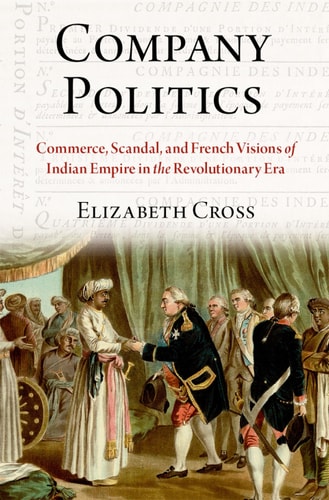
Company Politics: Commerce, Scandal, and French Visions of Indian Empire in the Revolutionary Era
0
0
As an Amazon Associate and affiliate partner, Menrva Books earns from qualifying purchases. Learn more
Author Description
In the wake of the Seven Years' War and the consolidation of British power on the subcontinent, the French monarchy chartered a new East India Company. The Nouvelle Compagnie des Indes was an attempt to maintain French diplomatic and financial credit among European rivals and trading partners within a region integral to the broader imperial economy. Reimagining French power as subsisting through an informal empire of trade, instead of a territorial empire of conquest, officials and intellectuals sought to remake the trading company as a private, "purely commercial" actor, rather than a sovereign company-state. Company Politics offers a new interpretation of political economy, imperialism, and the history of the corporation during the late Old Regime and the French Revolution. Despite its reputation for speculation, corruption, and scandal, Elizabeth Cross argues that the "New Company" emerged from the unique circumstances France faced in India as a weakened imperial power vis à vis the expanding British East India Company. Seeking to control the Company for their own purposes, French government officials, theorists, and private financial actors clashed over differing notions of political economy, debt, and imperial power for Europe and the Indian Ocean world. In doing so, they envisioned new alignments between state and market, challenged the legitimacy of the Old Regime's economic and imperial policies, and sought to revolutionize the underlying corporation itself through progressive demands of corporate self-governance. Thus, the New Company should be seen as an innovative capitalist actor in its own right, not a mere derivative of its Anglo-Dutch competitors.A valuable contribution to scholarship on capitalism, empire, and globalization, Company Politics uses the Company's history to present the Revolutionary Era as one of dynamic economic ideologies, practices, and experimentation, rather than only one of crisis and decline.
Menrva's Summary
THE THESIS
This book investigates how the Nouvelle Compagnie des Indes served as a critical site for debating the nature of French imperial power, corporate governance, and political economy during the late Old Regime and the French Revolution. Elizabeth Cross, a historian of early modern France and its empire, utilizes extensive archival research to challenge the narrative that the French East India Company was merely a failed imitation of its British counterpart. She argues that the company functioned as a laboratory for new economic ideologies, where state officials and private actors negotiated the boundaries between sovereign authority and commercial autonomy in an era of global competition.
THE SCOPE MAP
What You Will Find
- Analysis of the transition from territorial conquest models to informal trade-based imperial strategies.
- Examination of the political and financial conflicts between the French monarchy and private corporate actors.
- Use of primary source documentation from French administrative archives and corporate records.
- Exploration of the intersection between corporate self-governance and revolutionary-era economic theory.
THE AUTHORITY PERSPECTIVE
Scholars recognize this work as a significant re-evaluation of the French imperial experience, noting the author's ability to synthesize complex economic theory with political history. The text is considered a foundational resource for those studying the history of the corporation and the development of global capitalism in the eighteenth century.
Page Count:
306
Publication Date:
2023-01-01
Publisher:
Oxford University Press
ISBN-10:
0197653774
ISBN-13:
9780197653777
History
Commerce
French History
European History
Economic History
Imperialism
Economics history
Community Tags
Similar Books