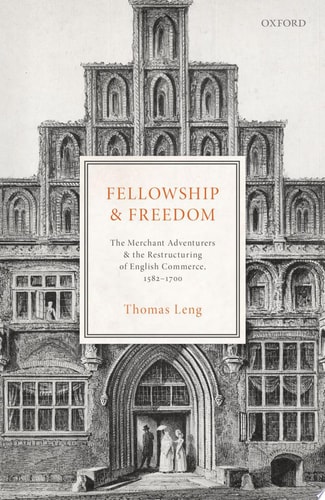
Fellowship and Freedom: The Merchant Adventurers and the Restructuring of English Commerce, 1582-1700
0
0
As an Amazon Associate and affiliate partner, Menrva Books earns from qualifying purchases. Learn more
Author Description
Intro -- Halftitle Page -- Title Page -- Copyright Page -- Contents -- Acknowledgements -- Abbreviations -- Conventions For Dating, Transcriptions, And Money -- Introduction: The Fellowship Of Merchant Adventurers After Antwerp -- Part One -- 1. Becoming A Merchant Adventurer -- The Beginnings Of Service -- In The Mart Town -- Transitions To Independence -- Establishing A Household -- Conclusion -- 2. Show Days: The Government Of Trade -- The Formation Of Networks -- Managing The Packhouse -- Beyond Cloth -- Conclusion -- 3. Running On The Exchange -- Desperate Times The Failure Of Richard Sheppard -- 'a Walking, Talking, Dead Man': The Consequences Of Failure -- Conclusion -- 4. Disorderly Brethren? Merchant Adventurers And The Company -- The Nature Of Participation -- The Costs And Benefits Of Membership -- The Mart System In Practice -- Conclusion -- Part Two -- 5. 'the Odious Name Of A Monopolist': From The Imperial Mandate Of 1597 To The 1604 Free Trade Bill -- 'devyded Into Three Partes' -- From The Imperial Mandate To The Free Trade Bill Of 1604 -- Conclusion 6. 'a New & Extraordinary Service To Be Done To The State And Comonwealth Of England': The Merchant Adventurers And The Cokayne Project -- The Merchant Adventurers On The Eve Of The Project -- 'no Newe Service To The State' -- 'to Be Free Of All Trade For All Places' -- Conclusion -- 7. 'a New Spirit Of Dissention And Disturbance': Religious And Political Divisions, C.1630-60 -- 'to Raigne As King In This Company': Edward Misselden And The Merchant Adventurers At Delft -- 'tossed In One Tempest': The Rotterdam And Hamburg Residences In The Civil War 'contrary To The Good Orders Of Our Fellowship': Hamburg In The 1650s -- Conclusion -- 8. 'that Trade Which Their Charter Reaches Not': Contesting The Company From The Restoration To The Glorious Revolution -- 'the Bare Interest Of Some Few Merchants': Defending The Monopoly -- 'soe Nactionall A Concerne': The 1683 Proclamation And Its Aftermath -- 'the Stran
Menrva's Summary
THE THESIS
This work investigates how the Merchant Adventurers of England navigated the transition from a medieval guild-based monopoly to the competitive commercial structures of the late seventeenth century. Thomas Leng, a historian specializing in early modern political and economic thought, utilizes company records, personal correspondence, and state papers to argue that the internal governance and external political pressures faced by the company were central to the development of English commercial policy. The book posits that the company's struggle to maintain its privileges against the rising tide of free trade ideology reflects the broader transformation of the English state and its economic identity.
THE SCOPE MAP
What You Will Find
- Analysis of the internal management of the Merchant Adventurers, including the mart system and packhouse operations.
- Examination of the Cokayne Project and its impact on the company's standing.
- Documentation of the political and religious divisions within the company during the English Civil War.
- Primary source evidence from company archives and contemporary pamphlets.
Scope Limits
- The study focuses primarily on the Merchant Adventurers and does not provide a comprehensive history of all English trading companies of the period.
- The analysis is limited to the timeframe of 1582 to 1700.
THE AUTHORITY PERSPECTIVE
Historians and scholars of early modern economic history recognize this text as a rigorous examination of the intersection between corporate governance and state policy. Readers frequently note the academic density of the prose, which provides a detailed look at the administrative mechanics of seventeenth-century trade.
Page Count:
352
Publication Date:
2020-01-01
Publisher:
Oxford University Press,
ISBN-10:
0192513303
ISBN-13:
9780192513304
History
History - Modern
Economic History
British History
HistoryCompany of Merchant Adventurers of England
Company of Merchant Adventurers of England
Commerce
Trade
Community Tags
Similar Books