November 1916
0
0
As an Amazon Associate and affiliate partner, Menrva Books earns from qualifying purchases. Learn more
Author Description
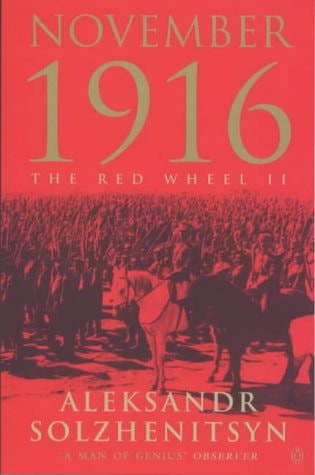
The month of November 1916 in Russia was outwardly unmarked by seismic events, but beneath the surface, society seethed fiercely. In Petrograd, luxury-store windows are still brightly lit; the Duma debates the monarchy, the course of war, and clashing paths to reform; the workers in the miserable munitions factories veer increasingly toward sedition. At the front all is stalemate except for sudden death's capricious visits, while in the countryside sullen anxiety among hard-pressed farmers is rapidly replacing patriotism. In Zurich, Lenin, with the smallest of all revolutionary groups, plots his sinister logistical miracle. With masterly and moving empathy, through the eyes of both historical and fictional protagonists, Solzhenitsyn unforgettably transports us to that time and place--the last of pre-Soviet Russia. Translated by H.T. Willetts.November 1916 is the second volume in Solzhenitsyn's multi-part work, the Red Wheel, following August 1914. The final volumes will deal with March and April of 1917. Each volume concentrates on a historical turning point, or "knot," as the wheel rolls on inexorably toward revolution.
Menrva's Summary
THE PULSE
As the Russian Empire approaches its collapse, the narrative captures the mounting tension and societal decay during the pivotal month of November 1916. Solzhenitsyn tracks the divergent paths of historical figures and fictional characters as they navigate a nation on the brink of radical transformation. The narrative framework utilizes a multi-perspective approach, shifting between the opulent streets of Petrograd, the stagnant front lines of the Great War, and the clandestine planning of revolutionaries in Zurich. These characters operate under the crushing weight of impending political upheaval, where the logical constraints of the crumbling monarchy clash with the rising fervor of sedition and economic desperation.
INSIDE THE PAGES
- Multi-perspective narrative structure
- Integration of historical figures with fictional characters
- Detailed depiction of pre-revolutionary Russian social strata
- Focus on the logistical planning of the Bolshevik movement
- Examination of the Duma's political debates
- Portrayal of the stalemate and attrition on the Eastern Front
- Analysis of the shift from patriotism to anxiety in rural populations
- Use of the "knot" concept to define historical turning points
THE COLLECTIVE ECHO
Readers and critics often note the immense scale and meticulous research present in this work. Discussion frequently centers on the author's ability to balance broad historical analysis with the intimate experiences of his characters. Many highlight the dense, atmospheric prose that effectively captures the mood of a society unaware of its imminent destruction. The pacing is described as deliberate, reflecting the slow accumulation of political pressure that eventually leads to the revolution. Observers appreciate the structural ambition of the series, noting how it functions as both a narrative and a historical record of a lost era.
Page Count:
1040
Publication Date:
2000-04-20
Publisher:
Penguin Books Ltd
ISBN-10:
0140071237
ISBN-13:
9780140071238
Historical Fiction
Russian
War
Revolution
Contemporary
Political fiction
Community Tags
Similar Books