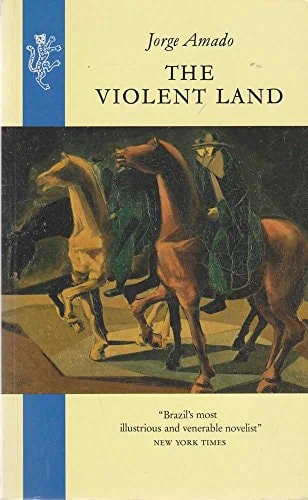
The Violent Land
0
0
As an Amazon Associate and affiliate partner, Menrva Books earns from qualifying purchases. Learn more
Author Description
Originally published in Portuguese in 1943 as Terras do sem fim by Livraria Martins Editoria, Brazil. In this short novel, the aristocratic Badaros family is pitted against the middle-class planter Colonel Horacio Silveira in a struggle to obtain a crucial piece of land for the growing of cacao. Amado's true subject—and one he frequently comes back to—is the effect of the Bahia region's vast cacao plantations on the local citizens and the communities in which they live.
Menrva's Summary
THE PULSE
A brutal struggle for control over fertile cacao territory ignites a violent conflict between rival land-owning factions in the Bahia region. The aristocratic Badaros family finds their dominance challenged by the ambitious Colonel Horacio Silveira, leading to a clash that reshapes the social and economic landscape of the frontier. Amado employs a third-person narrative perspective to examine the shifting power dynamics and the human cost of the cacao boom. The story unfolds within a harsh, unforgiving environment where legal and moral codes are secondary to the acquisition of land and wealth.
INSIDE THE PAGES
- Exploration of the socio-economic impact of the cacao industry on local communities
- Depiction of the transition from traditional feudal-style land ownership to capitalist expansion
- Focus on the moral decay and violence inherent in frontier land disputes
- Character-driven narrative highlighting the clash between old-world aristocracy and new-world ambition
- Vivid atmospheric descriptions of the Bahia region's geography and climate
- Examination of the exploitation of labor and the disenfranchisement of the local population
- Use of regional dialect and cultural markers to ground the narrative in its specific setting
- Critical commentary on the corruption of legal and political institutions in the face of greed
THE COLLECTIVE ECHO
This work is widely recognized as a cornerstone of Jorge Amado's early period, reflecting his commitment to social realism and the documentation of Brazilian regional history. Critics often highlight the novel's ability to balance intense, character-driven drama with a broader critique of the economic forces that shaped the Bahia frontier. The narrative is frequently praised for its unflinching portrayal of the violence and moral ambiguity that defined the cacao boom era. Readers and scholars alike note that the text serves as a vital historical document, capturing the tension between tradition and modernity in a rapidly changing society.
Page Count:
352
Publication Date:
1989-01-01
Publisher:
Collins Harvill
ISBN-10:
0002710242
ISBN-13:
9780002710244
Historical Fiction
Political fiction
Contemporary
Regional
Latin American
Literature & Fiction
Social Realism