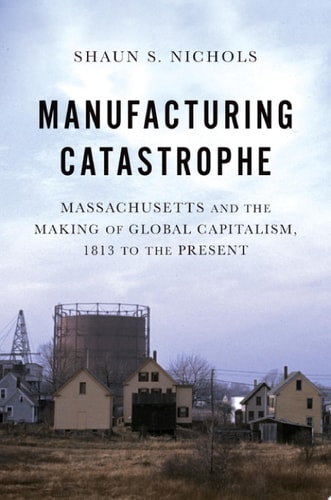
Manufacturing Catastrophe: Massachusetts and the Making of Global Capitalism, 1813 to the Present
0
0
As an Amazon Associate and affiliate partner, Menrva Books earns from qualifying purchases. Learn more
Author Description
American economic history has traditionally been told as a narrative of industrialization and affluence collapsing into globalization and industrial decay. Offering a reappraisal of this pattern, Manufacturing Catastrophe traces the successive rise and fall of the whaling, textile, garment, electronics, and high-tech industries in Massachusetts over the past two hundred years. It shows how business, labor, and political leaders repeatedly mobilized the lure of crisis―cheap labor, low taxes, and generous manufacturing subsidies―to pull and push both capital and workers across the continents, repeatedly remaking the pioneering industrial cities of Fall River and New Bedford. Workers―ranging from migrating Azorean seamen to British weavers to Quebecois farmers―and capitalists―including mobile manufacturers, globetrotting whalers, and multinational conglomerators―participated in the creation of regional growth and, with it, American industrial ascendance. Exploring the paradoxical and recurring coexistence of high unemployment and labor shortages in these cities, this book explains why recovery and growth have not necessarily translated into long-term prosperity. In doing so, it illuminates how economic catastrophe was, ironically, a critical ingredient in the making of America's industrial hegemony.
Menrva's Summary
THE THESIS
This book investigates how the recurring cycle of economic crisis in Massachusetts served as a foundational mechanism for the development of global capitalism. Shaun Nichols, Ph.D., utilizes a historical framework to analyze the rise and fall of diverse industries, including whaling, textiles, and high-tech manufacturing. By examining the actions of business leaders and the experiences of a diverse labor force, the author argues that industrial hegemony was built upon the strategic manipulation of economic instability and labor mobility.
THE SCOPE MAP
What You Will Find
- A longitudinal study of Massachusetts industrial history from 1813 to the present.
- Analysis of the whaling, textile, garment, electronics, and high-tech sectors.
- Examination of labor migration patterns involving Azorean, British, and Quebecois populations.
- A critique of the relationship between regional economic growth and long-term prosperity.
THE AUTHORITY PERSPECTIVE
Scholars and historians recognize this work as a rigorous re-examination of American industrialization that challenges traditional narratives of steady economic progress. Readers frequently note the dense, analytical nature of the prose, which provides a comprehensive look at how local economic policies influenced global capital movements.
Page Count:
378
Publication Date:
2024-01-01
Publisher:
Oxford University Press
ISBN-10:
0197665314
ISBN-13:
9780197665312
History
Economics
Industries history
Labor Studies
Economic History
American History
Capitalism
Industrial history
Industries
Community Tags
Similar Books