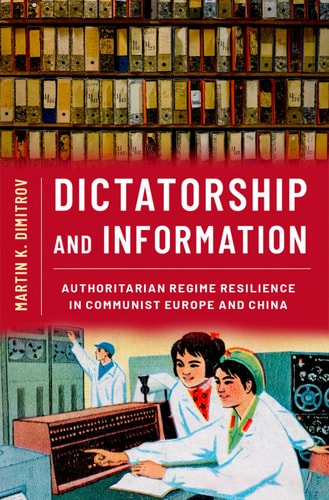
Dictatorship and Information: Authoritarian Regime Resilience in Communist Europe and China
0
0
As an Amazon Associate and affiliate partner, Menrva Books earns from qualifying purchases. Learn more
Author Description
Fear pervades dictatorial regimes. Citizens fear leaders, the regime's agents fear superiors, and leaders fear the masses. The ubiquity of fear in such regimes gives rise to the "dictator's dilemma," where autocrats do not know the level of opposition they face and cannot effectively neutralize domestic threats to their rule. The dilemma has led scholars to believe that autocracies are likely to be short-lived.Yet, some autocracies have found ways to mitigate the dictator's dilemma. As Martin K. Dimitrov shows in Dictatorship and Information, substantial variability exists in the survival of nondemocratic regimes, with single-party polities having the longest average duration. Offering a systematic theory of the institutional solutions to the dictator's dilemma, Dimitrov argues that single-party autocracies have fostered channels that allow for the confidential vertical transmission of information, while also solving the problems associated with distorted information. To explain how this all works, Dimitrov focuses on communist regimes, which have the longest average lifespan among single-party autocracies and have developed the most sophisticated information-gathering institutions. Communist regimes face a variety of threats, but the main one is the masses. Dimitrov therefore examines the origins, evolution, and internal logic of the information-collection ecosystem established by communist states to monitor popular dissent. Drawing from a rich base of evidence across multiple communist regimes and nearly 100 interviews, Dimitrov reshapes our understanding of how autocrats learn--or fail to learn--about the societies they rule, and how they maintain--or lose--power.
Menrva's Summary
THE THESIS
This book investigates how single-party authoritarian regimes utilize institutional information-gathering systems to mitigate the 'dictator's dilemma' and maintain political stability. Martin K. Dimitrov, a scholar of comparative politics, utilizes a framework centered on the vertical transmission of information within communist states. By analyzing the internal logic of surveillance and dissent-monitoring ecosystems, he argues that the longevity of these regimes is directly linked to their ability to process accurate data about popular sentiment and potential threats.
THE SCOPE MAP
What You Will Find
- A comparative analysis of information-gathering institutions in communist regimes across Europe and China.
- A theoretical framework explaining the 'dictator's dilemma' and institutional solutions for autocrats.
- Empirical evidence derived from nearly 100 interviews and historical state records.
- An examination of the evolution of surveillance mechanisms designed to monitor and neutralize popular dissent.
THE AUTHORITY PERSPECTIVE
Experts in comparative politics and authoritarian studies recognize this work as a significant contribution to the understanding of regime resilience. Readers frequently note the academic density of the prose and the depth of the institutional analysis provided by the author.
Page Count:
490
Publication Date:
2022-01-01
Publisher:
Oxford University Press
ISBN-10:
0197672957
ISBN-13:
9780197672952
History
Communism
International relations
Government
Comparative Politics
Sociology
Community Tags
Similar Books